Will your artificial intelligence body heal systems or fracture them?
Executive Summary: Health and Human Services (HHS) leaders stand at a strategic turning point. AI no longer delivers value through isolated tools alone. Real enterprise transformation emerges when Machine Learning, Large Language Models, Retrieval-Augmented Generation, agents, and Model Context Protocol function like an integrated human body. Leaders who design intelligence, memory, execution, governance, and payment into connected systems will outperform those deploying fragmented pilots. In modern HHS, architecture matters more than algorithms.
Introduction to AI Body Truths and Potential AI Failures
Imagine a large behavioral health network under pressure from clinician shortages, rising call volumes, reimbursement strain, and expanding patient demand. Leadership deploys a sophisticated chatbot to reduce intake delays. The tool communicates clearly, schedules quickly, and cuts wait times.
Yet it lacks access to verified payer rules, cannot retrieve clinical policies, and has no crisis escalation pathway. Within weeks, errors rise. Trust erodes. Staff overrides the system. Leaders realize they did not build transformation. They purchased a disconnected organ.
That scenario now defines the central challenge in AI for health and human services. The future of HHS will not be decided by who buys the smartest software. It will be decided by who builds the healthiest systems.
The AI Body Analogy
Most health and human services leaders do not need to become engineers, coders, or data scientists. They need something more operationally powerful. They need to understand how AI functions as a living enterprise system.
The distinction matters.
Too often, AI gets introduced through jargon, vendor hype, or isolated technical functions. Leaders hear terms like Machine Learning, Large Language Models, Retrieval-Augmented Generation, agents, and Model Context Protocol. Yet, many still struggle to translate those concepts into operational design, workforce strategy, governance, and measurable outcomes.
The human body analogy changes that.
| Capability | Human Analogy / Role | What It Does | Applications | Risks |
| Machine Learning (ML) | Pattern Recognition / Detects trends, predicts probabilities / | Learns from historical structured data to identify patterns, classify, score risk, and forecast outcomes | Claims fraud detection, readmission prediction, staffing optimization, population health risk, utilization forecasting | Poor forecasting, hidden fraud, reactive management, weak predictive capacity |
| Large Language Model (LLM) | Brain / Thinks, synthesizes, communicates | Processes language, summarizes complexity, drafts content, reasons probabilistically, and supports decision augmentation. | Clinical documentation, prior authorization drafts, leadership communication, policy summaries, and patient education | Hallucinations, misinformation, persuasive inaccuracy, poor judgment, if ungrounded |
| Retrieval-Augmented Generation (RAG) | Memory / Grounds intelligence in trusted knowledge | Retrieves current validated policies, regulations, evidence, and internal guidance before generating responses | CMS regulations, Veterans Affairs policy, Defense Health Agency guidance, payer requirements, behavioral health protocols | Dangerous misinformation, policy drift, compliance gaps, unverified outputs |
| Agents | Hands and Feet / Executes operational tasks | Performs actions autonomously or semi-autonomously based on goals and permissions | Appointment scheduling, referral routing, outreach campaigns, call center automation, and follow-up coordination | Unsafe automation, uncontrolled actions, patient safety risks, workflow chaos |
| Model Context Protocol (MCP) | Connects / systems, permissions, and context | Links AI systems to software, workflows, user permissions, and enterprise data sources. | Electronic Health Record integration, Customer Relationship Management systems, payer databases, scheduling platforms, and enterprise interoperability | Siloed pilots, disconnected workflows, inefficiency, and fragmented operations |
The framework matters because HHS leaders already understand body failure. A brain without memory may sound intelligent, but it makes dangerous decisions. Memory without hands cannot act. Hands without nerves create disorder. Pattern recognition without cognition becomes narrow and reactive. Nerves without governance may transmit dysfunction faster.
The same applies to AI. For example, a behavioral health chatbot powered by a Large Language Model may communicate well. Yet without Retrieval-Augmented Generation, it may reference outdated mental health policy. Without agents, it cannot schedule follow-up. Without the Model Context Protocol, it cannot connect to Electronic Health Records. Without TIMEOUT AUTHORITY, it may mishandle crisis escalation.
The result is not a transformation. It is a fragmented anatomy. Understanding the body is step one. Designing it properly determines success or failure.
Potential Failure #1. Overvaluing Machine Learning Without Strategic Integration
Machine Learning remains one of healthcare’s most operationally mature forms of AI. It excels at processing structured data, identifying trends, and forecasting likely outcomes. Claims fraud detection, readmission prediction, appointment no-show modeling, and workforce planning all benefit.
Yet Machine Learning often creates a false sense of modernization. Many organizations deploy predictive models while leaving workflows, staff behaviors, and governance untouched. Pattern recognition alone does not redesign systems.
The hidden risk is narrow optimization without enterprise redesign. A model may accurately predict high-risk patients, but if no connected care pathway exists, the prediction becomes administrative noise.
Machine Learning identifies problems. It does not solve system dysfunction alone. Prediction without thought is limited. Thinking without truth is dangerous.
Potential Failure #2. Treating Large Language Models Like Truth Engines
Large Language Models changed HHS by simulating reasoning, summarizing complexity, and accelerating communication. In 2023, Nature reported that advanced medical LLMs encoded significant clinical knowledge, creating major opportunities for education, documentation, and support.
Yet language fluency can mislead leaders. Large Language Models do not “know” truth. They predict plausible language. Without grounding, hallucinations remain a strategic and clinical threat.
For HHS leaders, policy summaries, mental health guidance, and prior authorization recommendations can sound authoritative could be dangerously wrong. A brain without memory may still speak confidently.
Large Language Models amplify cognitive speed, but ungrounded intelligence can erode trust. Trust demands memory.
Potential Failure #3. Ignoring Retrieval-Augmented Generation as Organizational Memory
Retrieval-Augmented Generation changes AI from persuasive guesswork into accountable enterprise intelligence. RAG retrieves trusted information from policy repositories, payer rules, clinical protocols, and regulatory frameworks before generating responses.
In HHS, AI memory is operationally critical. CMS guidance, Veterans Affairs policies, HIPAA protections, and behavioral health protocols evolve rapidly. RAG anchors AI to the current state of the truth.
Without a memory function, organizations deploy brains disconnected from institutional reality. Memory is the part where many pilots fail. They communicate well but cannot defend their answers. Trusted intelligence still fails if it cannot act.
Potential Failure #4. Deploying Agents Without TIMEOUT AUTHORITY
Agents represent the move from thinking to doing. They schedule, route, automate outreach, trigger workflows, and increasingly influence operational decisions. These are the processes where enterprise value accelerates and where liability explodes.
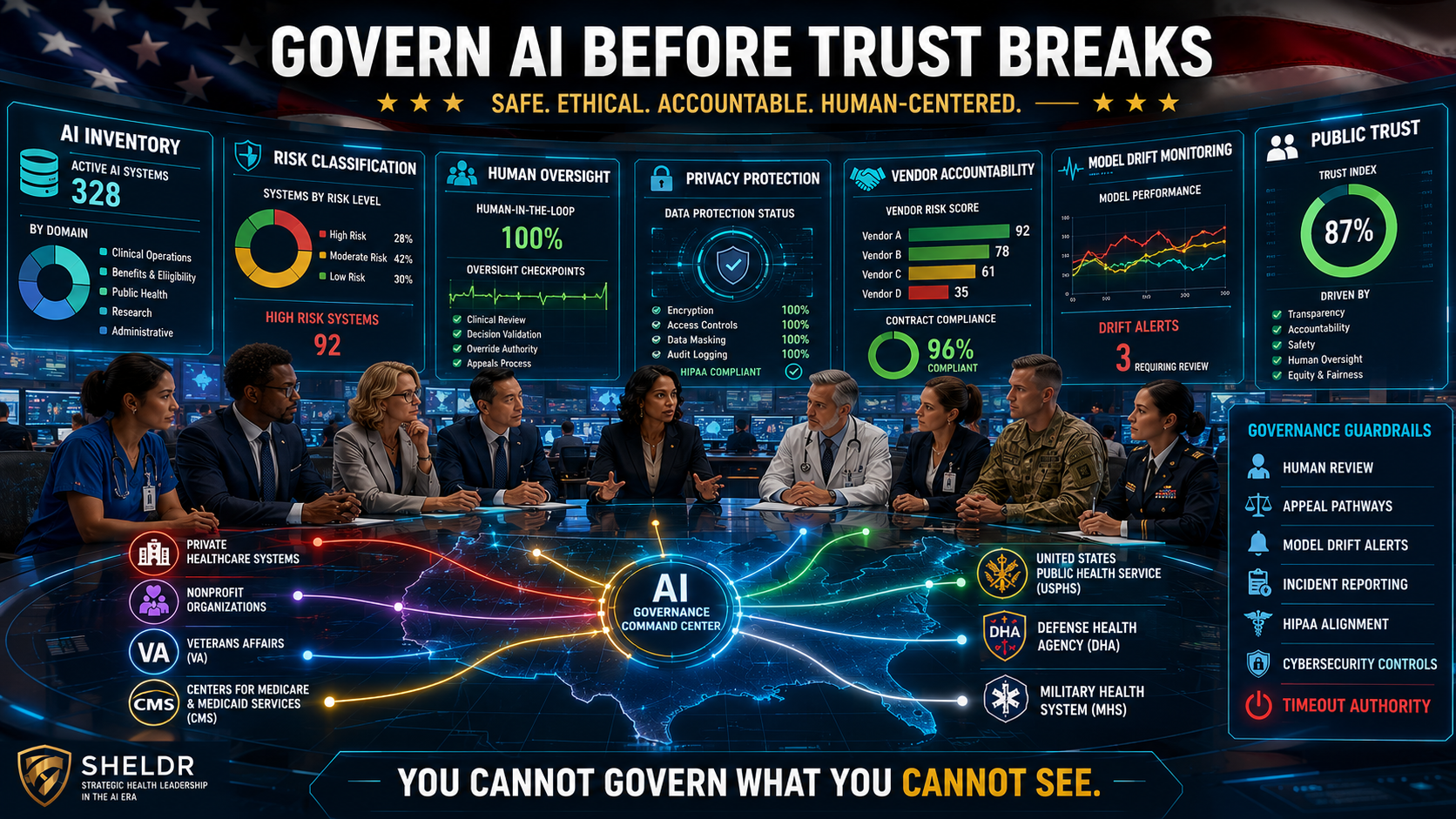
A scheduling agent that reduces friction may be transformative. A behavioral health triage agent without human override could create catastrophic harm. TIMEOUT AUTHORITY may be one of the most important missing governance structures in HHS AI adoption. Every agentic system should include:
- Escalation triggers
- Human override
- Safety shutdown
- Accountability chains
Disconnected autonomy creates speed without control. Agents create workforce power only when bounded by governance. Action still collapses if systems cannot communicate.
Potential Failure #5. Underestimating Model Context Protocol and Enterprise Connectivity
Model Context Protocol serves as the nervous system. It connects AI tools to Electronic Health Records, scheduling systems, payer databases, Customer Relationship Management platforms, and operational permissions. Without connectivity, organizations create pilot chaos:
- One chatbot
- One predictive tool
- One call center assistant
- No shared physiology
With connectivity, they build enterprise intelligence ecosystems. ONC interoperability mandates and CMS AI guidance increasingly matter. Federal direction increasingly emphasizes accountable integration over fragmented innovation.
Connectivity transforms isolated intelligence into operational redesign. Integration reveals the next frontier.
From AI Adoption to Enterprise Architecture
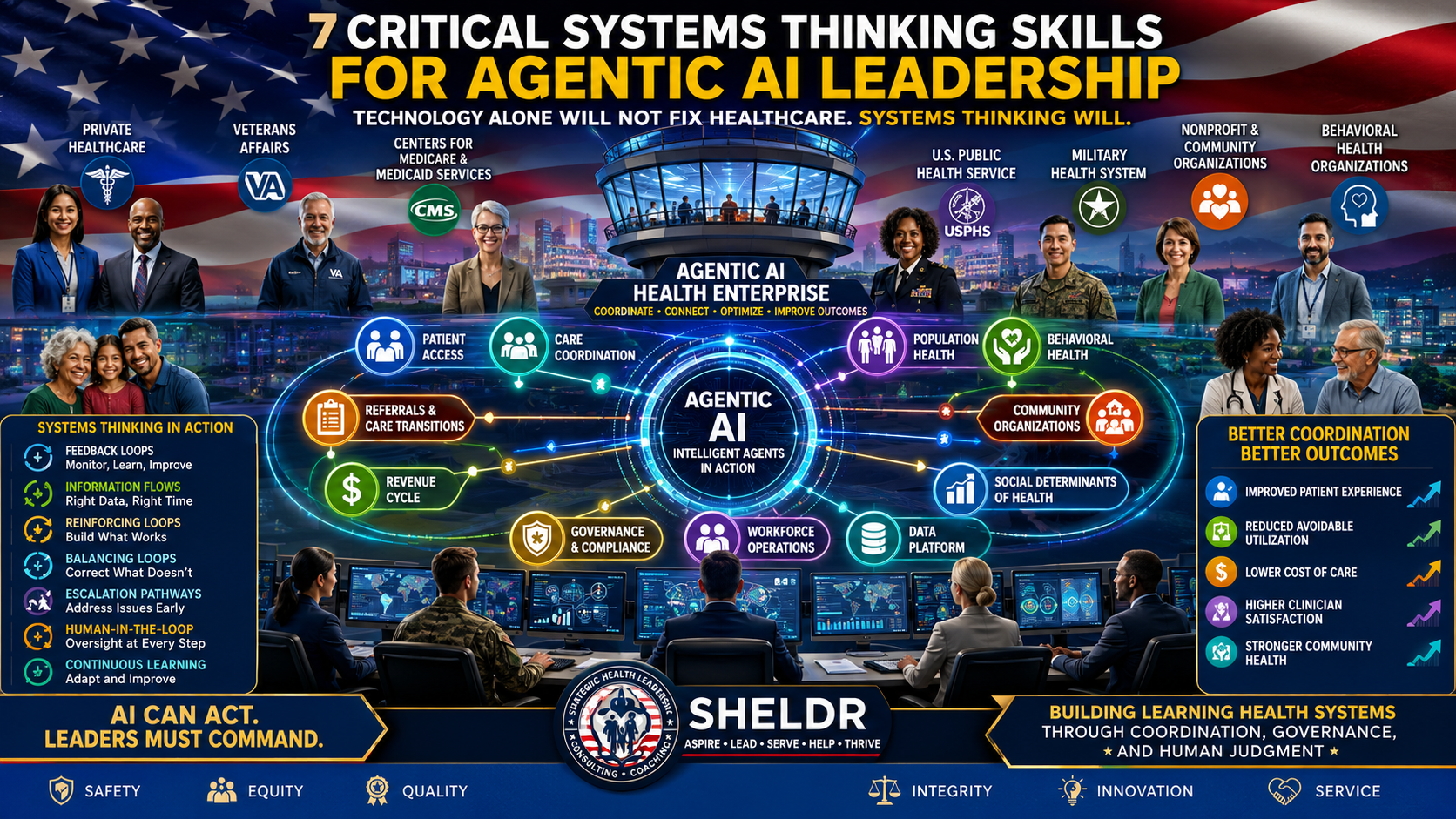
Mitigate all five failures by building an enterprise AI governance architecture before scaling tools. Pair Machine Learning with workflow redesign, Large Language Models with Retrieval-Augmented Generation, agents with TIMEOUT AUTHORITY, and Model Context Protocol with interoperability standards. Require human oversight, policy grounding, escalation pathways, reimbursement alignment, and cross-system integration. Do not deploy isolated intelligence: design connected, governable operational physiology.
The next Generation of health and human services winners will almost certainly be defined less by who adopts artificial intelligence first and more by who designs it best. Early adoption created momentum. Mature architecture will determine survival.
For too many organizations, artificial intelligence still operates like scattered organs on a table. One predictive model sits in the revenue cycle. One chatbot lives in customer service. One documentation assistant supports clinicians. One behavioral health pilot exists in isolation. Each tool may work independently, yet the enterprise still struggles because disconnected capabilities do not create operational health.
The strategic frontier has shifted. Health leaders must now move from experimentation to physiology.
| Missing Frontier | Why It Matters | Leadership Action |
| AI Operating Model Design | Fragmented adoption | Build an enterprise AI blueprint |
| TIMEOUT AUTHORITY | Safety and override | Design escalation systems |
| AI Reimbursement Alignment | Financial sustainability | Link to CMS and payer pathways |
| Workforce Cognitive Redesign | Role disruption | Retrain for augmentation |
| Behavioral Health AI Governance | High-risk exposure | Prioritize human oversight |
These issues matter because they connect strategy to operational sustainability. HHS systems face rising burnout, reimbursement compression, administrative drag, behavioral health crises, and trust erosion. Artificial intelligence can either amplify these fractures or redesign them.
Most organizations are not failing because artificial intelligence is weak. They are failing because the system design is immature.
Build the Body, Not the Buzzwords
You would never ask a surgeon to save a patient using disconnected organs. Yet many leaders still deploy AI that way. The strategic imperative is clear:
- Design the body.
- Connect the parts.
- Govern aggressively.
- Protect judgment.
- Align reimbursement.
- Lead workforce redesign.
AI transformation in HHS is not software modernization. It is an enterprise physiological redesign. Leaders who understand the distinction will not merely adopt AI. They will shape safer, smarter, more accountable systems that improve access, trust, outcomes, and resilience.
Learn More: Hard Truths and 5 Actions: AI’s Shortcomings in Health Leadership + BONUS
Discussion Questions
- Which part of your organization’s artificial intelligence body is missing or dangerously disconnected?
- Does your governance structure keep pace with your automation?
- Are you deploying pilots or designing enterprise physiology?
References
U.S. Department of Health and Human Services. Artificial Intelligence Strategy. Published 2025. https://www.hhs.gov/programs/topic-sites/ai/index.html
Ayers JW, Poliak A, Dredze M, et al. Comparing physician and artificial intelligence chatbot responses to patient questions. JAMA Intern Med. 2023;183(6):589-596. https://jamanetwork.com/journals/jamainternalmedicine/fullarticle/2804309
Singhal K, Azizi S, Tu T, et al. Large language models encode clinical knowledge. Nature. 2023;620:172-180. https://www.nature.com/articles/s41586-023-06291-2
Office of the National Coordinator for Health Information Technology. Hospital trends in use, evaluation, and governance of predictive AI, 2023-2024. Accessed 2026. https://www.healthit.gov/data/data-briefs/hospital-trends-use-evaluation-and-governance-predictive-ai-2023-2024/
Centers for Medicare & Medicaid Services. Guidance for Responsible Use of Artificial Intelligence at CMS. Published 2026. https://security.cms.gov/policy-guidance/guidance-responsible-use-artificial-intelligence-ai-cms