Will you lead the AI era by matching the right tool to the right task, or fall behind using average tools for exceptional challenges?
Executive Summary: Strategic leaders who win with AI do not ask which single platform is best. They ask which tool best fits the mission. IDOTS, It Depends on The Situation, reframes AI as a toolkit, not a religion. ChatGPT drives versatility, Claude sharpens deep analysis, Gemini powers Google workflows, Perplexity strengthens research, and Copilot accelerates Microsoft productivity. The advantage now belongs to professionals who experiment, compare, and strategically integrate multiple AI tools into daily operations. Smart adoption, disciplined testing, and leader-led example separate relevance from irrelevance.
Harnessing AI for Strategic Leadership
I get asked this constantly: “Which AI tool should I use?” My answer is always the same. It depends on the situation — IDOTS. Most professionals waste time trying to force one platform to do everything, then wonder why the results are mediocre.
The real productivity jump comes when leaders match the right tool to the right mission. Just like no hospital runs on one system alone, no serious professional should rely on one AI for every task. Effectiveness comes from strategic selection, disciplined testing, and smart adaptation. Here are the main contenders:
Understanding AI Tools: The landscape of AI tools is rapidly evolving, requiring leaders to stay informed and adaptable.
Step 1: AI Tool Contenders
- ChatGPT (OpenAI): This tool is a versatile all-rounder that uses GPT-5.4. It excels in conversational logic, coding, and general-purpose creativity.
- Claude (Anthropic): This tool is known for superior writing, deep reasoning, and massive context windows (200k+ tokens), making it the premier choice for document analysis.
- Gemini (Google): Optimized for Google Workspace users, this tool has native multi-modality and real-time internet access for up-to-the-minute data.
- Perplexity AI: This is the definitive research tool, designed to act as a conversational search engine with cited sources for accuracy.
- Copilot (Microsoft): This tool is the enterprise productivity partner, tightly integrated into Microsoft 365, offering secure workflows within Word, Excel, and Teams.
Watch this video to compare a few tools: ChatGPT, Claude, and Gemini.
To truly be productive, professionals must embrace a multi-AI strategy, using different platforms to test, experiment, and evaluate which AI best suits their immediate requirements, and act as leaders by example. Incorporate clear evaluation metrics and success indicators to guide your testing process, ensuring your choices align with strategic goals.
Step 2: AI Contender Assessment
AI in 2026 is no longer about picking a winner. It is about building an “AI toolkit mindset.” ChatGPT, Claude, Gemini, Perplexity, and Copilot each bring distinct strengths, weaknesses, and strategic value.
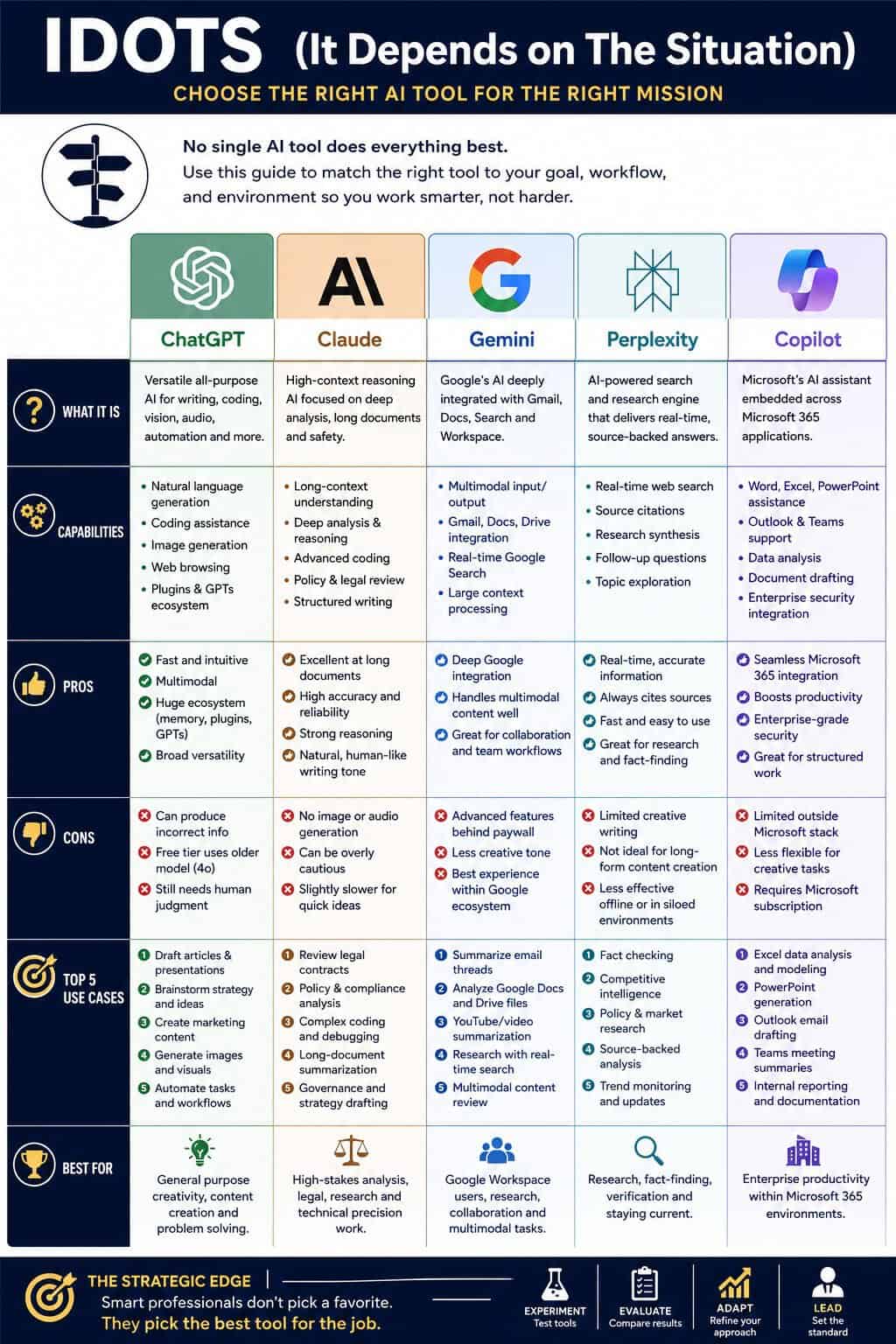
Embracing AI in 2026 means moving beyond one-size-fits-all solutions. The IDOTS approach requires matching tasks to tools and integrating them smoothly into existing workflows. As artificial intelligence advances, the competitive advantage lies in experimentation, rigorous testing, and evaluating these platforms for your unique workflows, ensuring seamless adoption without disruption.
By intentionally selecting the right tool for the job—whether it is Perplexity for research, Claude for writing, or Copilot for productivity—efficiency increases. This also serves as a model for adopting intelligent workflows.
Step 3: Understanding the Applications and Make a Selection
ChatGPT: The Swiss Army Knife: ChatGPT remains the best starting point for most users because it handles broad tasks well. Writing, strategic brainstorming, content creation, image generation, and workflow support all sit in its wheelhouse. Top 5 Use Cases: Drafting articles and presentations, Brainstorming strategy, Marketing content creation, Visual generation, and workflow automation. Bottom line: Start here if you need versatility.
Claude: The Deep Thinker: Claude excels when the stakes are high. Long contracts, policy analysis, strategic frameworks, and technical writing often feel sharper here. Top 5 Use Cases: Legal review, Policy analysis, Complex coding, Long-document summarization, Governance drafting. Bottom line: Use Claude when precision, coherence, and depth matter more than speed.
Gemini: The Google Insider: If your professional life runs through Gmail, Google Docs, Drive, and YouTube, Gemini can save enormous time. Top 5 Use Cases: Email thread analysis, Google Docs synthesis, YouTube/video summarization, Collaborative prep, Multimodal content review. Bottom line: Best for Google-native professionals.
Perplexity: The Research Analyst: Perplexity shines when verification matters. It often functions like an AI-powered research assistant. Top 5 Use Cases: Fact checking, Competitive intelligence, Policy research, Source-backed analysis, Trend monitoring. Bottom line: Trust but verify. This advice is your reconnaissance platform.
Copilot: The Enterprise Workhorse: Copilot is less flashy, but in Microsoft-heavy environments, it becomes operationally powerful. Top 5 Use Cases: Excel analysis, PowerPoint generation, Outlook drafting, Teams meeting summaries, and internal enterprise reporting. Bottom line: Ideal for structured enterprise execution.
Summary and Conclusion
The biggest mistake leaders make is treating AI like a religion instead of a toolkit. Unquestioning loyalty creates blind spots and overdependence. Strategic leaders must test platforms, compare outputs, assess tradeoffs, and continuously adapt—through governance-to avoid overreliance and ensure balanced, effective use of AI in decision-making.
Those who embrace AI with discipline will outperform those who avoid it or use it carelessly. Experiment. Test. Compare. Evaluate. Build your own decision matrix. Use these tools the way great leaders use teams, by understanding strengths, compensating for weaknesses, and leading by example.
In the AI era, relevance belongs to those who adapt fastest and think smartest.
More articles on AI at the SHELDR website: HERE Check out this article: 6 Urgent Organizational Governance Actions to Manage Agentic AI Such as OpenClaw Risks.