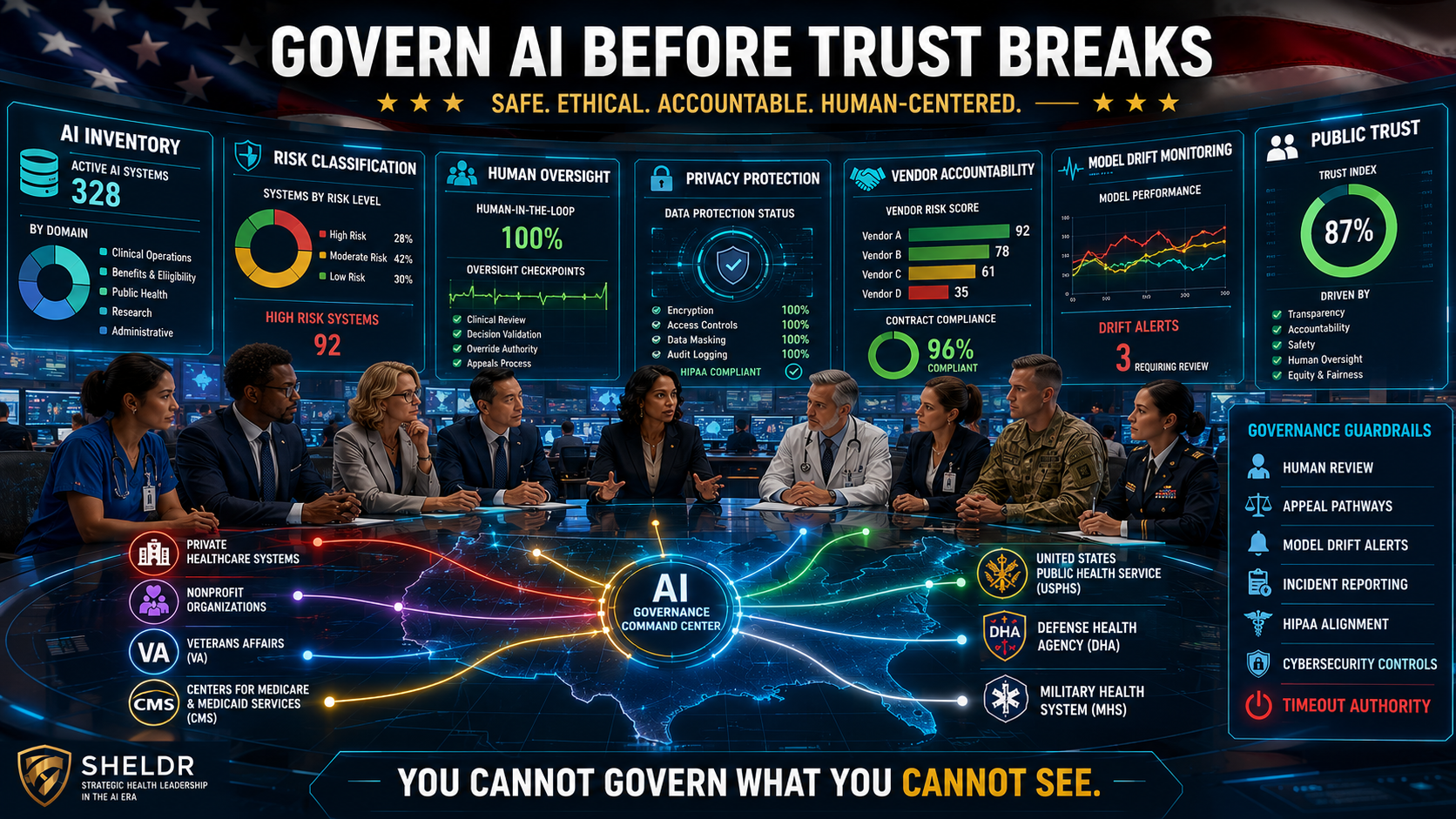
Can leaders govern AI before public trust breaks?
Why AI Governance Determines Public Trust
Health and Human Services (HHS) artificial intelligence (AI) governance protects care, privacy, funding, research, access, and public trust. Leaders must inventory AI systems, classify risk, assign owners, monitor drift, oversee vendors, and preserve human judgment. Without disciplined governance, AI can scale harm faster than executives can detect, explain, or correct it.
Why HHS AI Governance Cannot Wait
A regional health system buys an AI tool to speed prior authorization, identify high-risk patients, and support staffing forecasts. The software vendor promises faster approvals and staffing efficiency. Six months later, clinicians report unexplained denials, data teams find model drift, compliance staff discover weak documentation, and executives realize no one owns the system’s full risk.
That moment should feel familiar. According to the HHS AI Strategy, AI deployment now spans operations, research, and public health systems. It is the cockpit warning light HHS leaders cannot ignore.
AI governance works like mission command for advanced aircraft. Advanced AI-enabled systems can improve operational speed, targeting precision, and organizational awareness. Leaders still own the mission, the controls, the safety procedures, and the decision to abort unsafe action.
AI Governance Protects HHS Mission Operations
HHS AI governance means the policies, roles, controls, oversight practices, and monitoring routines that keep AI safe, lawful, explainable, secure, accountable, and aligned with mission. HHS now frames AI adoption as a department-wide strategy across operations, research, public health, and human services. CMS guidance also tells employees and contractors to use AI securely, ethically, and consistently with privacy laws and agency policy.
That matters because AI increasingly affects eligibility, scheduling, utilization management, program integrity, fraud detection, patient access, clinical support, research, and public health surveillance. AP reported that HHS expects a 70% increase in AI deployment from 2024 to 2025. HHS also maintains an AI use case inventory, which confirms that AI tools already exist across agency functions. As stated by CMS guidance, AI use must remain secure, ethical, and privacy-aligned across agency operations.
The table below translates governance from abstract policy into operating controls. These controls help leaders see what exists, who owns it, and how to control risk before the system influences care, payment, benefits, or public trust.
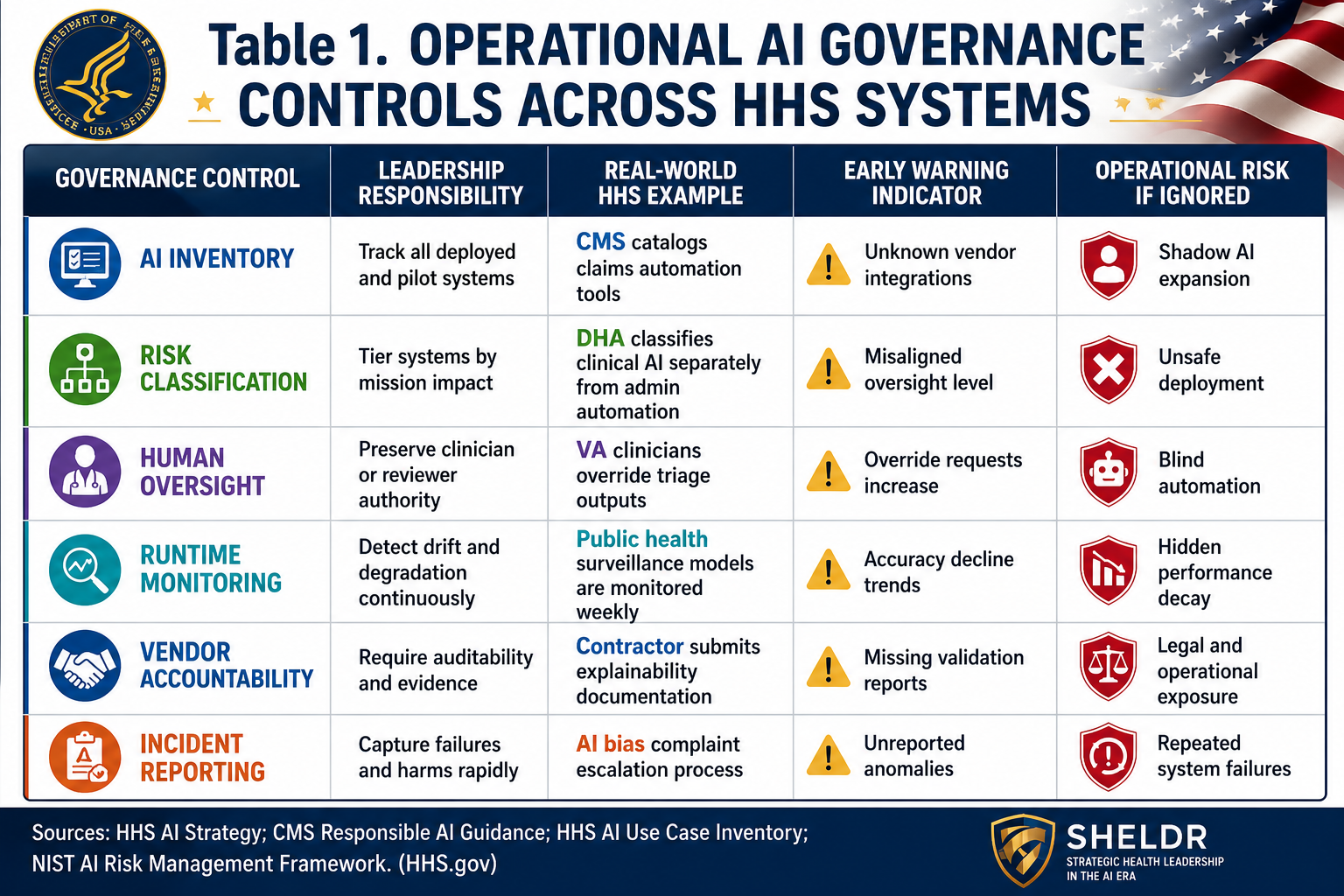
HHS AI governance provides leaders with the operational discipline to govern systems that influence care, payment, research, access, benefits, and public trust. A mission commander would never fly blind. HHS leaders should not scale invisible AI. The next issue involves the specific roles leaders must assign before deployment.
5 Notable AI Governance Failures HHS Leaders Ignore
Many HHS leaders still ask, “Who owns AI?” According to OMB M-24-10, agencies must assign accountable officials for high-impact AI systems. The better question is sharper: who owns each risk, decision, control, vendor, dataset, and outcome? AI governance fails when accountability becomes so thin that no leader can stop unsafe deployment, explain a decision, or respond to an audit.
NIST released the AI Risk Management Framework in 2023 to help organizations manage AI risk. OMB M-24-10 also established federal agency requirements for AI governance, innovation, and risk management, including minimum practices for AI that affect rights and safety. CMS guidance adds a blunt accountability point: individuals and teams employing AI or machine learning at CMS remain responsible for system outputs.
The table below identifies five roles HHS leaders should operationalize. The scenario failed because the organization bought speed before assigning command authority.
Table 2. Enterprise AI Governance Leadership Roles
| Governance Role | Operational Authority | Real-World HHS Example | Key Decision Responsibility | Failure if Missing |
| AI System Owner | Own lifecycle accountability | CMS contractor AI lead | Pause unsafe deployment | No accountable leader |
| Data Steward | Protect data integrity | Claims validation oversight | Approve data inputs | Corrupted outputs |
| Clinical Reviewer | Validate patient safety impact | VA physician review board | Approve clinical use | Unsafe recommendations |
| Privacy Officer | Protect PHI and compliance | HIPAA workflow audits | Approve data access | Privacy violations |
| Vendor Oversight Lead | Verify contractor compliance | Procurement governance reviews | Validate vendor evidence | Vendor risk illusion |
| Governance Council | Coordinate enterprise oversight | HHS AI governance committee | Prioritize risk decisions | Fragmented oversight |
Sources: CMS Responsible AI Guidance; OMB M-24-10; NIST AI RMF; HHS AI Strategy, CMS Security and Privacy Program
Section Summary: Governance succeeds when leaders assign owners before launch. AI cannot sit in a gap between information technology, compliance, clinicians, vendors, and executives. Named accountability prevents drift, confusion, and unsafe reliance.
The cockpit now needs the right instruments.
AI Governance Concepts HHS Leaders Must Master
HHS leaders do not need to become data scientists. They do need governance fluency. Boards, executives, program managers, clinicians, and contracting officers must understand enough to question vendors, challenge assumptions, and recognize failure signals.
These concepts include governance debt, model drift, shadow AI, vendor risk illusion, AI inventories, runtime governance, AI literacy, and explainability. The HHS Strategy also emphasizes inventories, risk guardrails, human oversight, privacy, infrastructure, workforce upskilling, and public trust.
Two facts sharpen the point. HHS strategy now pushes AI adoption across public health, research, and operations. CMS guidance states that AI use must protect sensitive information and build public trust. The table below gives HHS leaders a practical vocabulary. These concepts belong in executive briefings, procurement reviews, board dashboards, compliance reviews, and leadership development programs.
Table 3. Ten AI Governance Concepts HHS Leaders Need
| Concept | Meaning | HHS Example | Leader Action |
| Governance Debt | Risk created by delayed controls | Unreviewed chatbot spreads across offices | Close gaps before scale |
| Model Drift | Performance changes after launch | The triage model weakens over time | Monitor continuously |
| Shadow AI | Unapproved tools or agents | Staff upload data to unsanctioned AI | Create safe, approved options |
| Vendor Risk Illusion | Vendor compliance does not equal your compliance | Contractor uses an opaque model | Require evidence |
| Inventory | List of systems, owners, and risks | HHS AI use case tracking | Update monthly |
| Runtime Governance | Oversight during use | Drift dashboards and incident alerts | Govern after launch |
| Explainability | Ability to show why the output occurred | Coverage recommendation rationale | Demand traceability |
| Human Oversight | Human review and appeal paths | Clinician override for high-risk output | Protect judgment |
| AI Literacy | Workforce understanding of safe use | CMS staff training | Train before access |
| Incident Reporting | Capture AI failures and harms | Bias or privacy event reporting | Treat it like a safety event |
Sources: HHS AI Strategy; HHS AI Use Case Inventory; CMS Responsible AI Guidance; NIST AI RMF; OMB M-24-10.
Governance vocabulary gives leaders the ability to see risk before it becomes scandal, audit failure, patient harm, or public distrust. HHS leaders need enough AI fluency to ask better questions. The next step turns vocabulary into action.
Launch a 90-Day AI Governance Sprint.
HHS leaders should not wait for a perfect enterprise office before acting. Start with a 90-day sprint. Treat it like a preflight inspection before the aircraft enters crowded airspace. According to the Department of Defense Responsible AI pathway, continuous monitoring remains mission-critical after deployment. The goal is not bureaucracy. The goal is visibility, ownership, risk control, and trust.
The HHS AI Strategy, CMS responsible-use guidance, and NIST AI RMF point toward the same practical direction: inventory systems, classify risk, assign owners, apply privacy and security controls, train the workforce, monitor performance, and preserve human oversight. HHS also released a compliance plan for OMB M-25-21 in 2025, indicating that federal AI compliance requirements continue to evolve.
The table below gives leaders a concrete start. Use it with executive teams, program directors, compliance officers, clinical leaders, and contracting staff.
Table 4. 90-Day HHS AI Governance Sprint
| Days | Governance Action | Product | Owner |
| 1-15 | Identify all AI tools and pilots | AI inventory | Chief AI or strategy lead |
| 16-30 | Classify risk by mission impact | Risk register | Governance council |
| 31-45 | Assign accountable owners | Ownership matrix | Executive sponsor |
| 46-60 | Review privacy, data, and vendors | Control checklist | Privacy and contracting leads |
| 61-75 | Define human oversight and appeals | Review policy | Clinical or program lead |
| 76-90 | Launch monitoring dashboard | Drift, incident, trust metrics | Operations lead |
Source: HHS AI Strategy; CMS AI Guidance; NIST AI RMF; OMB AI governance guidance.
The first governance move is not a committee. It is an inventory, a risk register, accountable owners, vendor review, human oversight, and monitoring. Leaders should build visibility before expanding use. Now, leaders must face what happens without discipline.
Emerging AI Governance Risks Leaders Ignore
Several missing topics deserve more attention: AI refusal authority, AI incident reporting, appeal rights, workforce trust dashboards, vendor audit clauses, cybersecurity alignment, model retirement rules, and cross-agency governance standards.
The bold idea is this: ungoverned AI should lose permission to operate.
Health leaders have already suspended unsafe medications, devices, processes, and vendors. AI systems that cannot explain decisions, identify owners, show performance, protect privacy, support appeal, or pass monitoring should face the same operational discipline.
This matters because AI is now embedded in HHS missions that directly affect the public. A flawed model can delay care. A weak vendor contract can expose data. A drifting tool can mislead staff. A hidden agent can make unauthorized changes. A poorly explained decision can destroy trust.
Do next: establish an AI governance council, publish a use-case inventory, require human oversight for high-impact decisions, integrate HIPAA and cybersecurity controls, create vendor evidence standards, train the workforce, and review performance at runtime.
Govern AI Before Public Trust Collapses
AI governance is the leadership discipline that keeps speed from becoming harm.
HHS leaders should stop treating governance as a compliance afterthought. They should run it like mission command. Every AI system needs an owner, a purpose, a risk tier, a monitoring plan, a privacy review, a vendor evidence file, and a human appeal path.
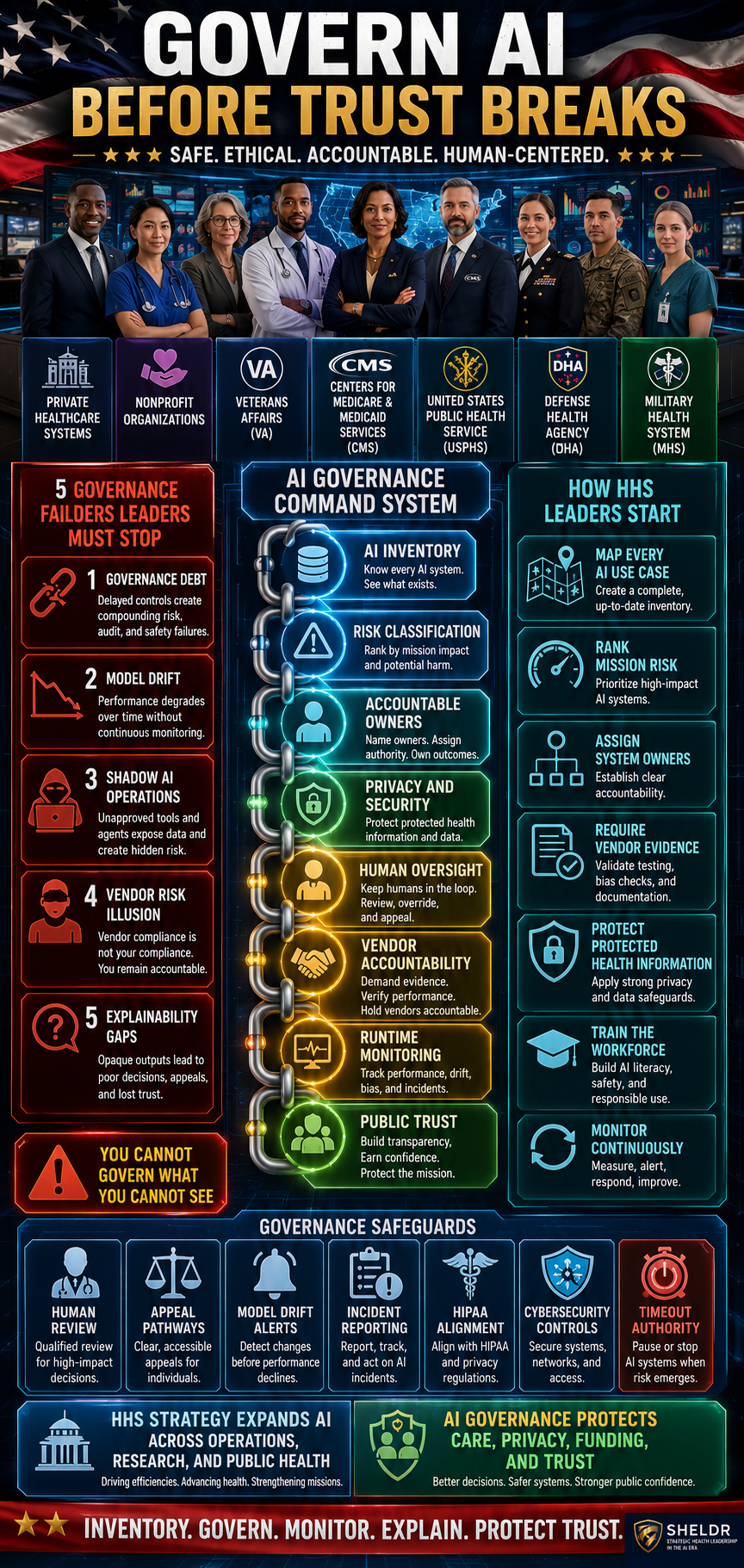
The central question is simple: can you explain, defend, monitor, and pause every AI system influencing your mission?
If not, do not scale it.
Discussion Questions
- Which deployed AI systems inside your organization currently lack runtime accountability and executive oversight?
- Which AI-supported decisions should always require a clinician or programmatic human override authority?
- Where could hidden vendor opacity create operational, legal, or patient safety exposure today?
- Which AI systems in your organization operate without named accountable owners?
References
- U.S. Department of Health and Human Services. AI Strategy. Published December 2025. https://www.hhs.gov/sites/default/files/hhs-artificial-intelligence-strategy.pdf
- Centers for Medicare & Medicaid Services. Guidance for Responsible Use of AI at CMS. Accessed May 22, 2026. https://security.cms.gov/policy-guidance/guidance-responsible-use-artificial-intelligence-ai-cms
- National Institute of Standards and Technology. AI Risk Management Framework. Released January 26, 2023. https://www.nist.gov/itl/ai-risk-management-framework
- Office of Management and Budget. M-24-10: Advancing Governance, Innovation, and Risk Management for Agency Use of Artificial Intelligence. Published March 28, 2024. https://www.whitehouse.gov/wp-content/uploads/2024/03/M-24-10-Advancing-Governance-Innovation-and-Risk-Management-for-Agency-Use-of-Artificial-Intelligence.pdf
- U.S. Department of Health and Human Services. HHS AI Use Case Inventory FY25. Accessed May 22, 2026. https://www.hhs.gov/sites/default/files/hhs-ai-use-case-inventory-fy25.csv