Can emotionally disconnected leaders survive accelerating AI disruption?
Why Emotional Intelligence (EQ) Determines AI Leadership Success
Artificial intelligence (AI) accelerates clinical, operational, and administrative execution across Health and Human Services (HHS) systems, but emotional intelligence (EQ) determines whether organizations maintain workforce trust, morale, resilience, and stability. Leaders who overvalue technical expertise while neglecting empathy, collaboration, emotional regulation, and self-awareness risk weakening operational performance precisely when AI increases organizational effectiveness.
Why AI Magnifies Emotional Intelligence (EQ) Failures
A large health system launches an enterprise AI initiative to improve staffing forecasts, automate documentation, and accelerate patient triage decisions. Executives celebrate implementation speed and productivity metrics during leadership briefings. Meanwhile, nurses, behavioral health professionals, and frontline clinicians quietly report emotional fatigue, distrust, communication breakdowns, and rising frustration with leadership responsiveness. One exhausted nurse finally states during a town hall meeting: “The technology works. Leadership stopped listening.”
That statement exposes the defining leadership challenge of the AI era. As the American Psychological Association states, workforce trust strongly influences the success of technology adoption.
AI may rapidly improve operational efficiency, but emotionally disconnected leadership weakens workforce trust, psychological safety, resilience, collaboration, and adoption across HHS systems. Like a fighter pilot flying advanced aircraft systems through severe turbulence, strategic health leaders now need both technical awareness and emotional discipline to guide teams safely through accelerating change.
The sections below explain why EQ now functions as operational infrastructure during AI-enabled transformation.
The EQ Gaps and Why EQ Defines Leadership Stability
Health leaders historically advanced through technical expertise, operational achievement, clinical mastery, financial performance, or strategic intelligence. AI changes leadership value dramatically because automation increasingly performs analytical, predictive, documentation, scheduling, and administrative functions previously associated with executive authority.
The dangerous misconception is believing intelligence alone creates leadership trust.
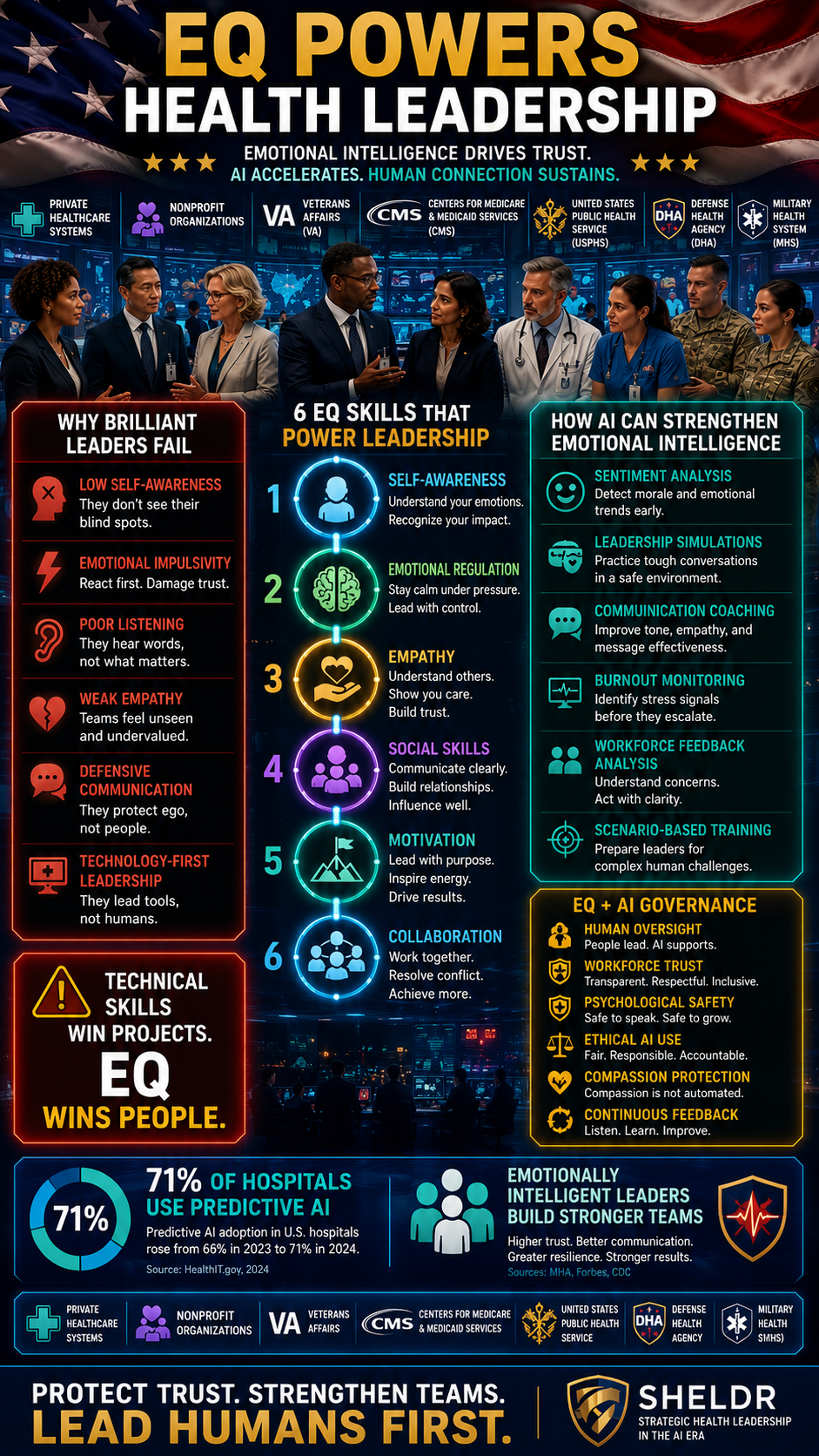
The Office of the National Coordinator for Health Information Technology reported predictive AI use in U.S. hospitals increased from 66% in 2023 to 71% in 2024. Simultaneously, workforce burnout, staffing shortages, psychological fatigue, and turnover continue to affect healthcare delivery nationwide.
AI increases operational speed while simultaneously magnifying weak communication, emotional impulsivity, defensive leadership behavior, and distrust. The ONC Predictive AI Trends Report documented rising enterprise AI adoption across hospitals between 2023 and 2024.
The table below explains why technically brilliant leaders often fail operationally despite intelligence, charisma, or strategic capability.
Table 1. Why Technically Brilliant Leaders Fail Operationally
| Leadership Trait | Hidden EQ Gap | Real-World HHS Example | Organizational Consequence | Long-Term Strategic Risk |
| High intelligence | Weak empathy | Executive dismisses frontline burnout concerns during staffing shortages | Workforce disengagement | Retention instability |
| Charisma | Poor listening discipline | The leader dominates operational meetings while ignoring warning signals | Psychological safety declines | Innovation suppression |
| Operational speed | Emotional impulsivity | Senior leader reacts defensively during crises | Trust deteriorates | Decision paralysis |
| Technical mastery | Weak collaboration | AI deployment bypasses clinician input | Adoption resistance | Failed transformation |
| Confidence | Low self-awareness | The executive ignores 360-degree feedback | Culture fragmentation | Leadership isolation |
| Strategic vision | Poor emotional regulation | Public health leaders escalate tension during emergencies | Team instability | Operational fatigue |
Sources: Harvard leadership research; CDC workforce guidance; APA leadership resources; ONC Predictive AI Trends Report.
Technical expertise may launch leadership careers, but EQ sustains operational legitimacy during pressure. As noted by Forbes healthcare leadership analysis, emotionally intelligent leaders sustain workforce trust during organizational disruption. Leaders who fail to strengthen emotional discipline, listening, and workforce trust increasingly create organizational friction while AI accelerates execution speed.
The next challenge involves mastering the six EQ capabilities defining future-ready leadership.
Six EQ Skills Drive Team Performance
AI increasingly handles workflow optimization, forecasting, automation, analytics, and communication support. That shift elevates EQ from a desirable leadership trait into mission-critical operational infrastructure. Leaders now guide emotionally strained humans through accelerating uncertainty rather than simply managing predictable workflows.
A mission commander succeeds during turbulence by remaining emotionally grounded while coordinating complex systems under pressure. Health leaders require the same balance during AI-enabled transformation.
Gallup and healthcare workforce studies continue reporting elevated emotional exhaustion among clinicians, nurses, behavioral health teams, and public health personnel. Simultaneously, research increasingly links emotionally intelligent leadership with improved teamwork, morale, retention, and communication effectiveness.
The table below explains how six EQ competencies directly influence workforce stability, organizational trust, and operational effectiveness across healthcare environments.
Table 2. Six EQ Competencies Defining AI-Era Leadership
| EQ Skill | Strategic Leadership Function | Real-World HHS Example | Operational Benefit | Risk if Weak |
| Self-awareness | Understand emotional impact on others | Executives recognize stress escalation during staffing shortages | Stabilizes culture | Fear-driven environment |
| Emotional regulation | Maintain calm during crises | Behavioral health leader steadies teams during surge events | Preserves trust | Emotional contagion |
| Empathy | Recognize workforce and patient concerns | Veterans Affairs leader openly addresses clinician fatigue | Strengthens morale | Workforce distrust |
| Social skills | Coordinate teams and relationships effectively | CMS modernization leader aligns cross-functional stakeholders | Improves collaboration | Silos deepen |
| Motivation | Sustain mission focus during adversity | Public health leader maintains outbreak-response momentum | Strengthens resilience | Team exhaustion |
| Collaboration | Resolve conflict constructively | The Defense Health Agency integrates military and civilian healthcare operations. | Enhances interoperability | Operational fragmentation |
Sources: Mental Health America; CDC leadership training; Frontiers in Psychology EQ research; Babson leadership research.
Mental Health America identifies emotional awareness and empathy as foundational workplace resilience capabilities for leadership. These competencies no longer function as optional “soft skills.” EQ now protects workforce trust, psychological safety, communication quality, and organizational adaptability during AI-enabled disruption.
AI itself also changes how leaders can develop EQ capabilities.
AI Can Strengthen EQ Development
AI cannot replace authentic empathy, compassion, or human connection. Machines may simulate supportive language patterns, but algorithms cannot reproduce lived experience, emotional sacrifice, or moral courage developed through patient care, crisis leadership, military medicine, behavioral health response, or public health emergencies.
Yet AI can strengthen EQ development when leaders use it responsibly.
Healthcare organizations increasingly use AI-enabled simulations, workforce sensing tools, communication analytics, and coaching systems to strengthen leadership awareness, conflict navigation, and emotional responsiveness. APA guidance and AI workforce studies also highlight growing interest in AI-supported emotional coaching and workforce wellbeing analytics.
The table below explains how AI can safely augment EQ development across HHS environments.
Table 3. Artificial Intelligence-Augmented EQ Development
| AI Capability | Leadership Development Benefit | Real-World HHS Example | Strategic Value | Human Responsibility |
| Sentiment analysis | Detect morale shifts earlier | Public health leaders monitor workforce stress trends | Earlier intervention | Interpret responsibly |
| Communication coaching | Improve empathy and tone | Executives receive feedback on email communication patterns | Better trust-building | Preserve authenticity |
| Simulation training | Practice difficult conversations safely | Leaders rehearse conflict-resolution scenarios | Safer leadership learning | Apply ethically |
| Burnout detection | Identify emotional fatigue patterns | Hospitals monitor workforce wellbeing indicators | Retention support | Protect privacy |
| Workforce feedback analysis | Strengthening listening discipline | Veterans Affairs teams analyze anonymous workforce concerns | Better responsiveness | Respond transparently |
| Scenario modeling | Improve emotional decision readiness | DHA leaders rehearse operational crisis communications | Faster stabilization | Maintain human judgment |
Sources: APA AI guidance; Frontiers in Psychology; National Council for Mental Wellbeing; HHS AI Strategy.
The danger arises when leaders attempt to automate emotional labor rather than strengthen authentic relationships. Emotionally disconnected automation weakens trust faster than efficiency gains improve workflows.
Emerging leadership risks now deserve urgent attention.
Emerging Leadership Risks Leaders Still Ignore
Several leadership capabilities remain dangerously underdeveloped across Health and Human Services systems despite the accelerating adoption of artificial intelligence. Many organizations still prioritize automation speed, workflow efficiency, and predictive analytics while underinvesting in workforce trust, emotional readiness, psychological safety, and compassionate leadership resilience.
That imbalance creates operational danger.
Healthcare organizations increasingly depend on emotionally stable leaders who can guide teams through uncertainty, burnout, staffing shortages, behavioral health strain, and AI-enabled disruption without weakening trust or human connection.
The table below highlights emerging gaps in emotional intelligence leadership that are now affecting healthcare operations, workforce resilience, and AI adoption maturity across HHS environments.
Table 4. Emerging Emotional Intelligence Leadership Risks in the AI Era
| Leadership Gap | Why It Matters | Real-World HHS Example | Operational Risk if Ignored |
| Workforce trust measurement | Distrust blocks AI adoption | Nurses reject poorly explained documentation systems | Technology failure |
| Psychological safety analytics | Fear suppresses communication | Staff avoid reporting workflow concerns during AI deployment | Hidden operational risk |
| Emotionally intelligent AI governance | Compassion must remain operationally protected | Behavioral health leaders preserve human review authority | Dehumanized care |
| AI-supported executive coaching | Leaders need emotionally realistic training environments | Hospital executives rehearse crisis communication scenarios | Poor crisis response |
| Burnout prediction governance | Emotional fatigue weakens patient safety | Public health teams monitor stress escalation trends | Workforce instability |
| Human-retained compassion standards | Algorithms cannot replace empathy or bedside judgment | Clinicians maintain override authority during difficult care decisions | Loss of trust and morale |
| Operational emotional readiness drills | Leaders must stabilize teams during disruption | Veterans Affairs leaders simulate surge-response coordination | Emotional chaos during crises |
The most provocative issue is this: AI increases the value of lived human experience. As stated by the HHS AI Strategy, responsible AI adoption requires preserving human-centered healthcare delivery and trust. Algorithms can summarize information, accelerate workflows, and support analysis, but machines cannot replace bedside judgment, emotional sacrifice, moral courage, crisis leadership, or authentic empathy forged through human service. Organizations that over-automate human interaction risk weakening morale, resilience, trust, and operational workforce stability.
AI magnifies emotional intelligence rather than replacing it. Leaders who combine technological acceleration with empathy, emotional discipline, workforce trust, and compassionate leadership will stabilize organizations faster than those relying solely on technical expertise or charisma.
The next challenge involves operationalizing emotional intelligence across enterprise healthcare leadership development systems.
AI Makes Human Leadership More Valuable
AI will not eliminate the need for EQ across HHS systems. It magnifies it. The future belongs to leaders who combine technological acceleration with empathy, emotional discipline, communication skills, workforce trust, and human-centered judgment. Strong leaders use AI like a mission commander uses advanced aircraft systems: as a force multiplier guided by emotional awareness, operational discipline, and ethical accountability.
The central question remains unavoidable: will AI strengthen human connection inside healthcare systems, or will emotionally disconnected leadership weaken trust faster than technology improves efficiency?
Learn More: 7 Brutal AI Truths Health Leaders Must Recognize – Is your team leading AI or absorbing avoidable risk?
Discussion Questions
- Which EQ capability currently limits leadership effectiveness most inside your organization?
- How can healthcare systems measure workforce trust before an operational breakdown occurs?
- How should leaders preserve authentic empathy while scaling AI-enabled operations?
References
- U.S. Department of Health and Human Services. Artificial Intelligence Strategy. Published 2025. Accessed May 21, 2026. HHS AI Strategy
- Office of the National Coordinator for Health Information Technology. Hospital Trends in Use, Evaluation, and Governance of Predictive AI, 2023-2024. Accessed May 21, 2026. ONC Predictive AI Trends Report
- American Psychological Association. Artificial Intelligence in Mental Health Care. Published 2024. Accessed May 21, 2026. APA AI in Mental Health Care
- Ayers JW, Poliak A, Dredze M, et al. Comparing physician and artificial intelligence chatbot responses to patient questions. JAMA Internal Medicine AI Chatbot Study JAMA Intern Med. 2023;183(6):589-596. doi:10.1001/jamainternmed.2023.1838. JAMA Internal Medicine Article
- Coalition for Health AI. Blueprint for Trustworthy AI Implementation Guidance and Assurance for Healthcare. Published 2023. Accessed May 21, 2026.
- Harvard Division of Continuing Education. Why Emotional Intelligence Is Critical for Successfully Managing Up. Accessed May 21, 2026. Harvard Emotional Intelligence Article
- Mental Health America. What Is Emotional Intelligence and How Does It Apply to the Workplace? Accessed May 21, 2026. Mental Health America Emotional Intelligence Resource
- Babson College. Why Is Emotional Intelligence Important in Leadership? Accessed May 21, 2026. Babson Emotional Intelligence Leadership Article
- Forbes. Why Emotional Intelligence Is More Critical Than Ever for Health Care. Published September 26, 2025. Accessed May 21, 2026. Forbes Emotional Intelligence Healthcare Article
- MGH Institute of Health Professions. Emotional Intelligence: A Critical Piece of Leadership in Health Professions Education. Accessed May 21, 2026. MGH Institute Emotional Intelligence Article
- B.E. Smith. The Importance of Emotional Intelligence in Leadership. Accessed May 21, 2026. B.E. Smith Emotional Intelligence Leadership Article
- Centers for Disease Control and Prevention. Workplace Health Model. Published 2024. Accessed May 21, 2026. CDC Workplace Health Model PDF
- Frontiers Research Topic. Emotional Intelligence and Artificial Intelligence in Mental Health. Accessed May 21, 2026. Frontiers of Emotional Intelligence and AI Research Topic
- The Inner Boardroom. Why Leaders Fail at Emotional Intelligence. Accessed May 21, 2026. The Inner Boardroom Emotional Intelligence Article
- Growth Foundry. The Role of the Leader in the Age of AI: How to Manage Hybrid Teams. Accessed May 21, 2026. Growth Foundry AI Hybrid Teams Article
#EmotionalIntelligence #HealthLeadership #ArtificialIntelligence