Will we allow AI to dull human intellect in healthcare permanently?
Cognitive Debt Rising
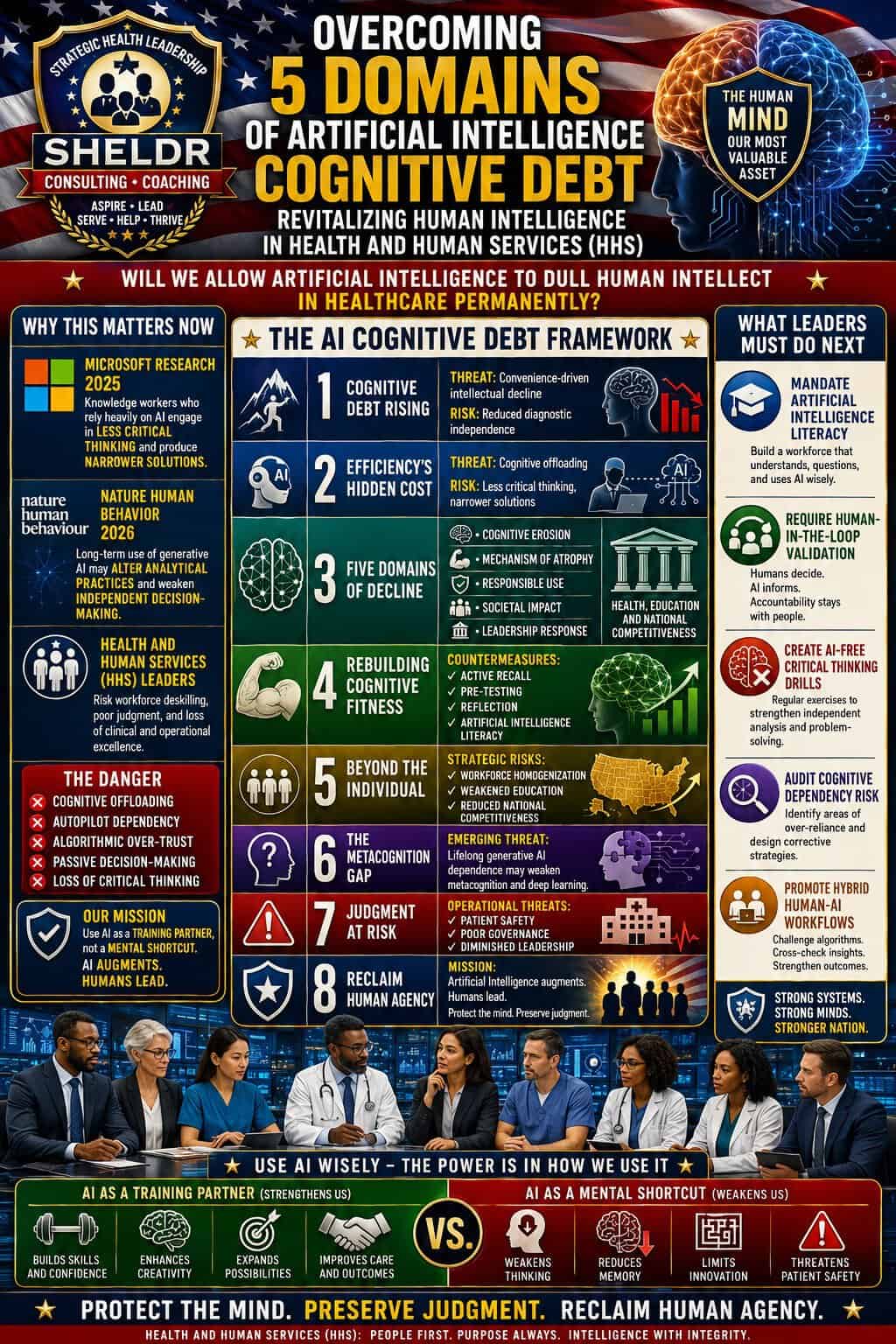
This commentary explores how cognitive offloading diminishes our critical faculties and outlines proactive strategies to preserve human intelligence. Imagine a clinician who, after years of relying on AI Cognitive Debt to synthesize patient data and suggest treatment plans rapidly, suddenly finds herself unable to diagnose a complex, edge-case illness on her own confidently. This scenario highlights the dangerous reality of AI Cognitive Debt and atrophy. To mitigate cognitive atrophy, humans must use AI Cognitive Debt as a training partner rather than a mental shortcut.
As artificial intelligence (AI) integrates into health and human services (HHS), leaders face an unprecedented challenge: Does rapid algorithmic convenience lead to intellectual stagnation? Before leaders can defend judgment, they must first recognize how convenience quietly weakens cognition.
Recognizing the implications of AI Cognitive Debt is vital for fostering a culture of critical thinking and innovation in health services.
By understanding AI Cognitive Debt, we can create frameworks that enhance decision-making processes in healthcare.
Understanding AI Cognitive Debt is crucial for developing effective training and decision-making processes in healthcare.
Understanding the role of AI Cognitive Debt is crucial for improving healthcare training and decision-making.
Efficiency’s Hidden Cost
AI tools hold transformative potential to process vast datasets and streamline administrative duties. However, a recent 2025 Microsoft Research study highlighted a concerning trend: knowledge workers who rely heavily on AI engage in less critical thinking and produce narrower solutions. AI is reshaping human cognition.
While AI enhances efficiency and automates routine processes, it introduces risks, such as “cognitive offloading” (delegating critical thinking to technology). Understanding the promise of AI is only the starting point; leaders must now confront its neurological tradeoffs.
Five Domains of Decline
Overcoming AI Cognitive Debt requires commitment to active learning and engagement in clinical settings.
The trend of AI Cognitive Debt poses significant risks to the quality of patient care.
| Area | Question Explored | Summary / Impact |
| Cognitive Erosion | Is AI eroding human cognitive skills? | Yes. Studies, including analyses by Microsoft Research and Carnegie Mellon, reveal that heavy reliance on AI reduces independent problem-solving and critical reasoning. |
| Mechanism | How is AI eroding cognitive skills? | Through cognitive offloading and cognitive atrophy. When users rely on AI for instant answers, they bypass active recall, synthesis, and deep analytical processing, much like muscle atrophy from lack of exercise. |
| Responsible Use | How to engage in cognitive fitness and use AI responsibly? | Individuals should use AI for brainstorming or menial task automation, but enforce independent “pre-testing,” active recall, and intentional AI literacy to keep their critical thinking sharp. |
| Societal Impact | What are the broader implications for society, work, and education? | Over-reliance risks a homogenized, “vanilla” workforce with diminished innovation, widening gaps in self-regulated learning, and challenges to national competitiveness. |
| Why it Matters & Next Steps | Why does it matter? What should health leaders do next? | If left unchecked, healthcare systems risk losing clinical judgment and analytical rigor. Health leaders should implement AI training wheels, mandate AI literacy training, and promote hybrid human-AI workflows. |
Instead of independent problem-solving, professionals become mere overseers, checking AI’s work rather than actively processing complex information. This over-reliance leads to cognitive atrophy.
Addressing AI Cognitive Debt is essential to rebuilding cognitive fitness within healthcare organizations.
When professionals delegate their analytical reasoning to AI, they experience a decline in independent decision-making. In health and human services, where patient outcomes depend on nuanced clinical judgment and compassionate evaluation, this trend threatens the foundational pillars of care. Once cognitive erosion is identified, the next imperative is to prevent passive dependence from becoming a professional default.
AI Cognitive Debt can lead to a significant decline in critical thinking and innovation across the workforce.
The discussion on AI Cognitive Debt highlights the importance of metacognitive awareness in healthcare.
Rebuilding Cognitive Fitness
Evaluating AI Cognitive Debt will help bridge the metacognition gap in health services.
To mitigate the erosion of essential cognitive skills, health professionals must engage in active “cognitive fitness.” This means using AI as an intellectual sparring partner to enhance, rather than replace, independent reasoning. Individuals can combat cognitive atrophy by practicing active recall, requiring pre-testing before utilizing AI tools, and prioritizing reflection.
By maintaining active mental engagement, professionals can leverage AI to improve efficiency without sacrificing their analytical edge. Individual resilience matters, but protecting one professional at a time will not solve system-wide consequences.
Leaders must address AI Cognitive Debt proactively to ensure the safety and efficacy of care provided.
Strategies to mitigate AI Cognitive Debt must be prioritized within health leadership training.
Beyond the Individual
The broader implications for society, workforce development, and national competitiveness are profound. If we allow foundational skills like memory, analytical thinking, and creativity to erode, we risk cultivating a homogenized, vanilla workforce. In the education and corporate sectors, reliance on AI limits innovative capacity.
Health professionals must recognize and combat AI Cognitive Debt to maintain their analytical prowess.
Ultimately, addressing AI Cognitive Debt is about reclaiming human agency in our decisions.
Therefore, organizations must intentionally foster higher-order thinking skills to remain competitive and adaptive. When cognitive debt scales across institutions, the challenge shifts from personal discipline to national strategic risk.
The Metacognition Gap
Discussion on AI Cognitive Debt is critical for future-proofing healthcare education and practices.
Understanding AI Cognitive Debt can foster better accountability in patient safety protocols.
Integrating strategies to combat AI Cognitive Debt is essential for sustainable healthcare practices.
The discussion surrounding AI’s impact on the brain is vast, yet an emerging gap is the long-term, lifespan effects of daily generative AI use on metacognition. While short-term task performance increases with AI, longitudinal data on whether the brain can retain deep learning without active recall is still developing.
Follow-on research must focus on designing “assistive” rather than “disruptive” cognitive architectures that build human capacity alongside AI capabilities. These unanswered long-term questions move this issue beyond productivity into leadership responsibility.
Judgment at Risk
This matters deeply to HHS leaders because algorithmic errors and over-trust in AI-generated information could directly jeopardize patient safety and systemic efficiency. If HHS leaders do not act, they risk leading a workforce incapable of independent, critical-thinking-based leadership.
Leaders must take decisive steps. They should mandate AI literacy, implement human-in-the-loop requirements for critical decisions, and encourage hybrid, human-AI workflows that actively challenge algorithms. If judgment is mission-critical, Health and Human Services leaders must now operationalize protection rather than simply acknowledge danger.
Reclaim Human Agency
The integration of AI in healthcare offers immense potential, provided we do not outsource our intellectual agency. Health and human services leaders must champion responsible AI adoption by cultivating cognitive fitness and active critical thinking.
I urge you to implement “AI-literacy” training wheels within your organization today to protect the long-term cognitive health of your workforce.
Learn more: 6 ChatGPT Assisted Leadership Tips for Accelerating and Overcoming Coding Bottlenecks.
Discussion Questions (Use the Image!)
- What systemic measures can health systems put in place to ensure AI is utilized to augment, rather than replace, clinical judgment?
- How can healthcare educators adapt curricula to prevent cognitive atrophy among the next generation of healthcare professionals?
- In what ways can cognitive offloading create liabilities in patient safety, and how might we measure this risk?
Use this image for the discussion
References
- Lee, H.-P. et al. (2025). “The Impact of Generative AI on Critical Thinking: Self-Reported Reductions in Cognitive Effort and Confidence Effects From a Survey of Knowledge Workers.” Proceedings of the 2025 CHI Conference on Human Factors in Computing Systems.
- Nature Human Behavior (January 2026). “The brain side of human-AI interactions in the long-term.”
- León-Domínguez E. Cognitive offloading or cognitive overload? How AI alters the mental architecture of learning. Front Psychol. 2025;15:12678390. PMC PubMed Central
- Microsoft Research and Carnegie Mellon University. AI is causing the deterioration of cognitive faculties. Published February 2025. YouTube
- IE University. AI’s cognitive implications: the decline of our thinking skills? Published February 2025. IE Center for Health and Well-Being
- Harvard Business Review (January 2026). “Why People Create AI ‘ Workshops’ and How to Stop It.”