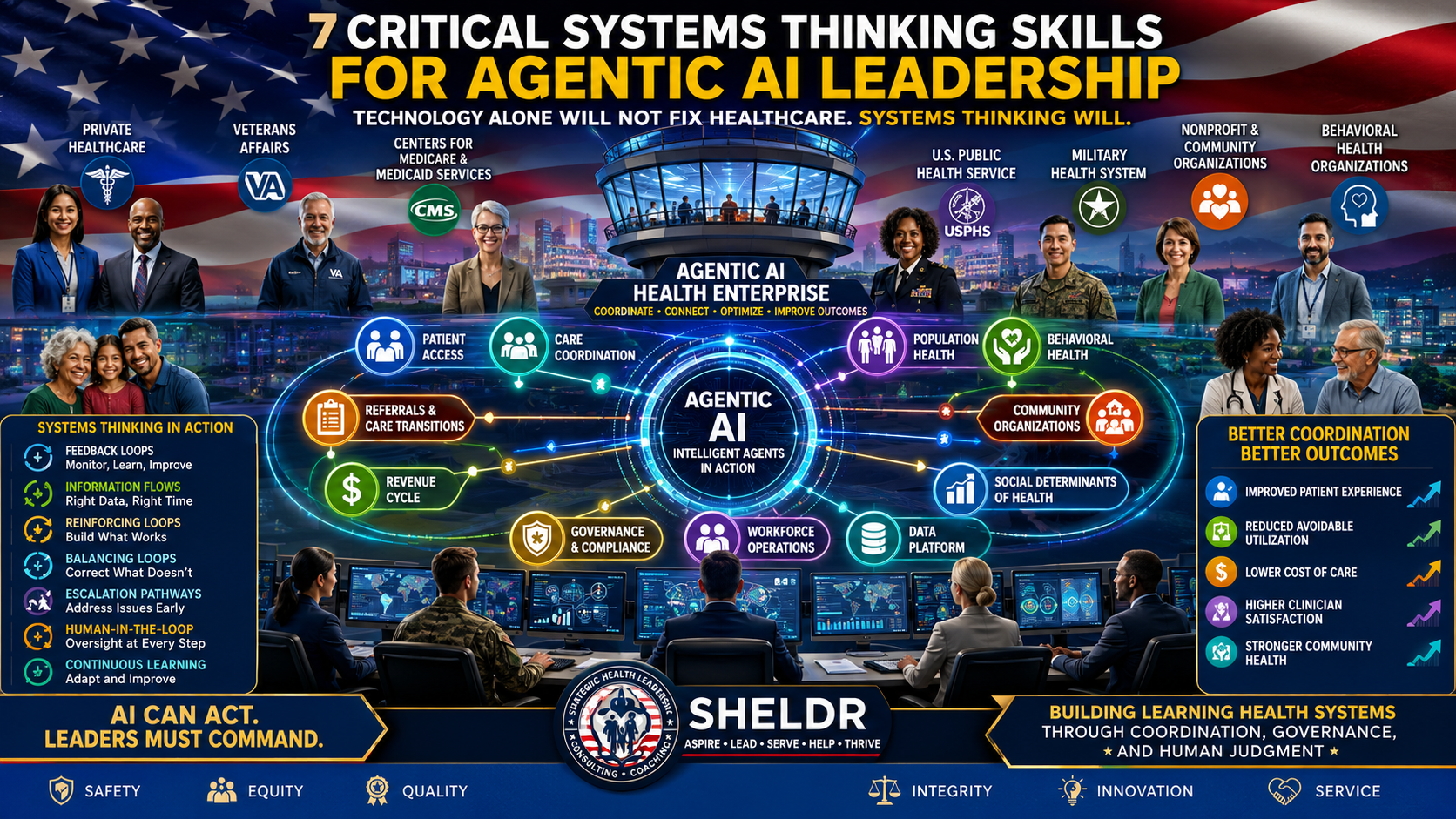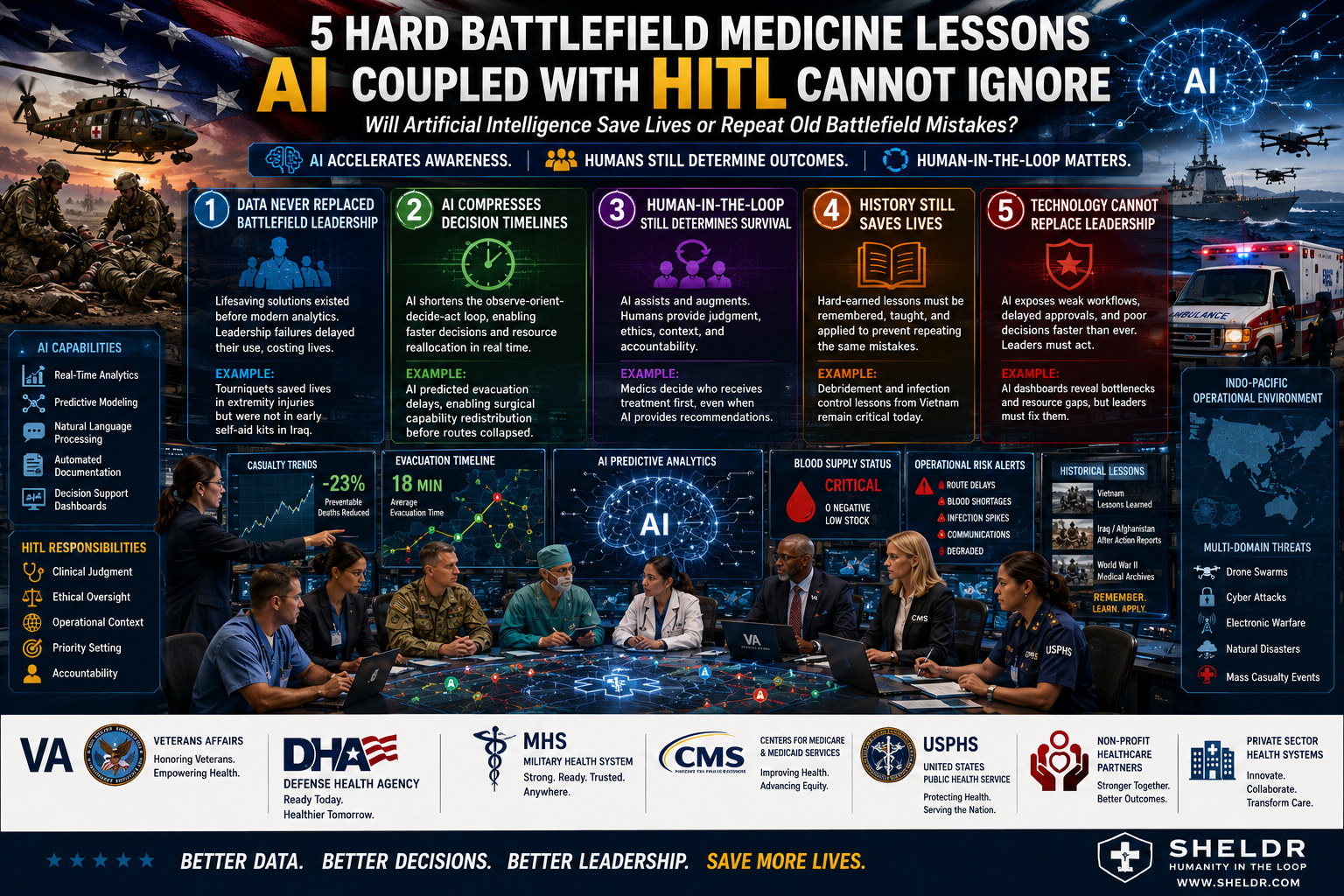
Can your strategy move faster than disruption does?
Executive Summary
Artificial Intelligence (AI) changes strategic planning by speeding up scanning, forecasting, decision support, monitoring, and course correction. Health and Human Services (HHS) leaders should not treat AI as a document-production tool. They should treat it as strategic radar. The leader still flies the mission. Governance, judgment, workforce readiness, and measurable outcomes must drive adoption.
Introduction to AI’s Impact and Opportunity On Health Strategy
Picture a Veterans Affairs access team facing rising appointment delays, staff shortages, and growing behavioral health demand. Under the old planning model, leaders would gather reports, brief committees, update slides, and revisit the issue during the next review cycle.
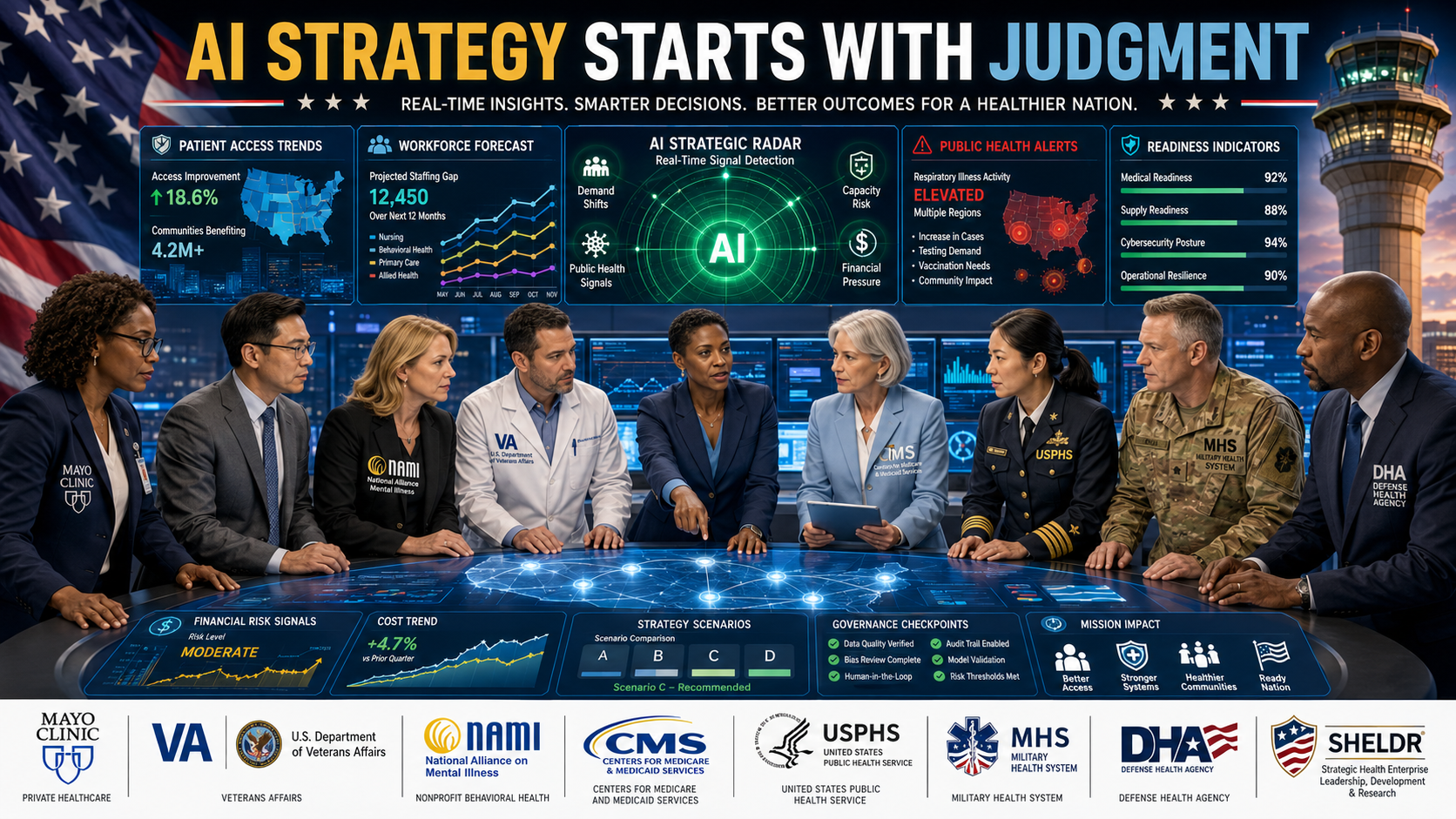
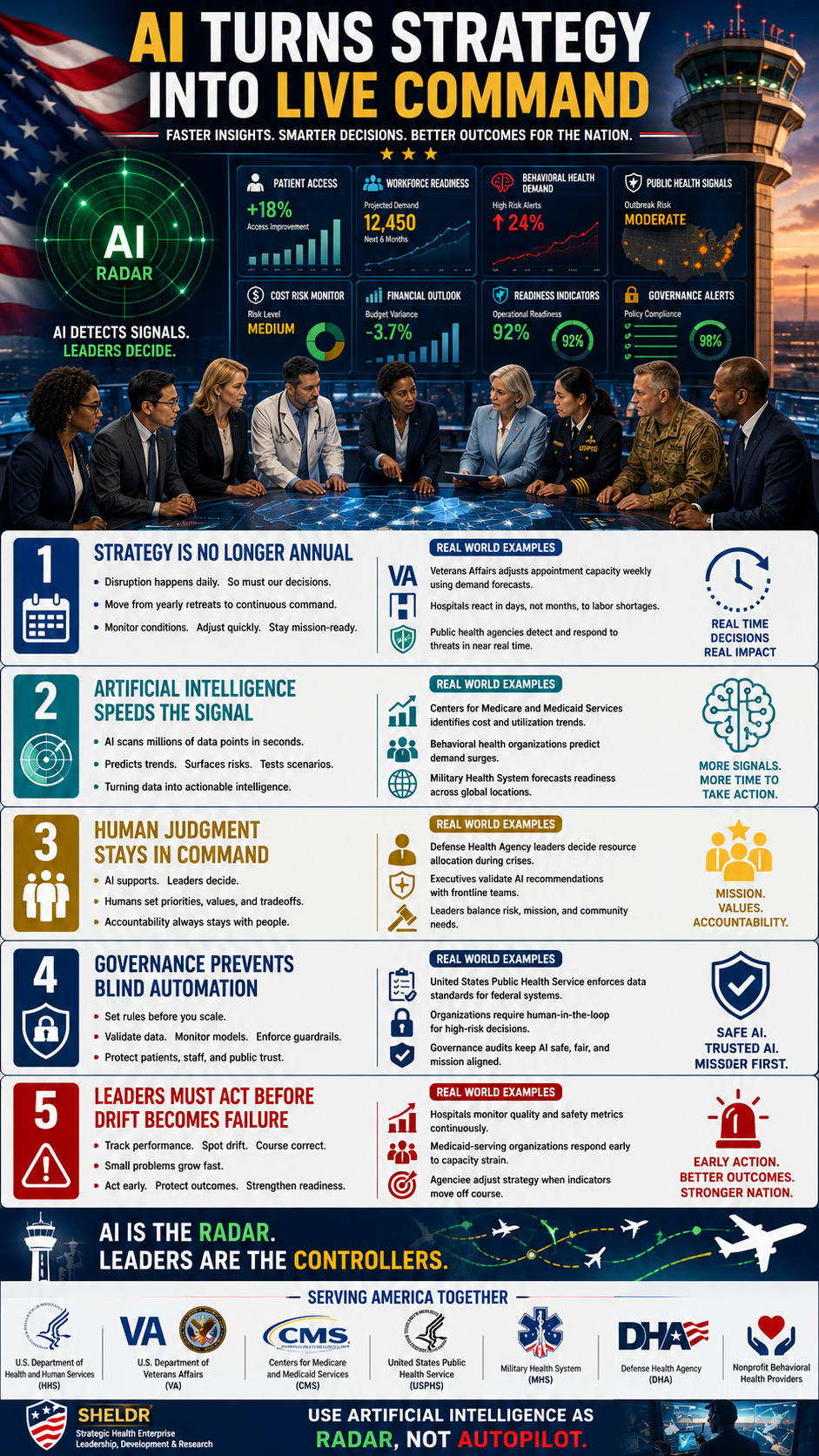
Now, picture an Artificial Intelligence-supported strategy center. The system flags demand shifts, predicts staffing gaps, compares options, and monitors whether corrective actions work. The leader still decides. The system improves sightlines.
That is the new strategic planning fight. AI turns slow planning into live command work.
Strategy Must Move Faster
AI changes strategic planning by altering tempo. HHS systems cannot manage workforce gaps, cyber risk, access delays, disease threats, and reimbursement shifts with annual planning rhythms alone.
A 2025 JAMA Network Open study found 31.5% of nonfederal US hospitals used generative AI in electronic health records in 2024. Another 24.7% planned adoption within one year. That finding matters because adoption has already moved into daily operations. The table below shows why HHS leaders need faster planning loops.
Table 1. From Annual Planning to Live Strategy
| Leadership Need | Slow Planning Response | AI-Enhanced Response | Operational Impact |
| Access delays | Quarterly review | Demand forecasting | Earlier intervention |
| Workforce shortages | Retrospective vacancy reports | Staffing risk prediction | Better deployment choices |
| Public health threats | Manual surveillance review | Signal detection | Faster response |
| Cost pressure | Delayed finance reports | Trend monitoring | Earlier resource decisions |
| Strategy execution | Annual update | Continuous tracking | Less drift |
Sources: Everson et al., 2025; Angus, 2025; American Hospital Association, 2025.
This does not mean leaders should unthinkingly chase speed. Bad decisions made faster still create harm. The air traffic control analogy helps. Radar gives earlier warning, but trained controllers still manage risk, sequence action, and protect lives.
AI shortens the planning cycle. Leaders must shorten governance and decision cycles with it. Speed without judgment creates expensive confusion.
Judgment Becomes the Strategic Advantage
AI can summarize, compare, forecast, and monitor. It cannot own mission risk. It cannot decide what a community deserves, what a workforce can absorb, or when a tradeoff violates organizational values. That distinction matters in HHS. Leaders manage human consequences, not abstract business indicators.
A 2024 JAMA article argued that generative AI may deliver meaningful healthcare improvements faster than earlier technologies. That speed increases the need for disciplined human oversight. A 2024 NEJM AI study of academic medical centers found that governance for predictive tools varies across organizations, indicating that many systems still lack mature oversight. The table below separates machine work from leadership work.
Table 2. What AI Can Support and What Leaders Must Own
| Strategic Task | AI Can Support | Leaders Must Own |
| Scan conditions | Detect patterns | Decide which signals matter |
| Build scenarios | Model options | Choose an acceptable risk |
| Draft priorities | Summarize choices | Set mission direction |
| Track results | Flag drift | Order corrective action |
| Communicate strategy | Prepare drafts | Build trust and commitment |
| Review risk | Identify concerns | Enforce accountability |
Sources: Wachter and Brynjolfsson, 2024; Nong et al., 2024; Coiera and Fraile-Navarro, 2024.
The scenario proves the point. If the Veterans Affairs access team receives an AI-generated staffing recommendation, executives still need to examine feasibility, labor relations, funding limits, patient risk, and public trust.
AI improves the view. Leaders still carry the decision. Governance turns faster visibility into safer action.
Governance Must Move Upstream
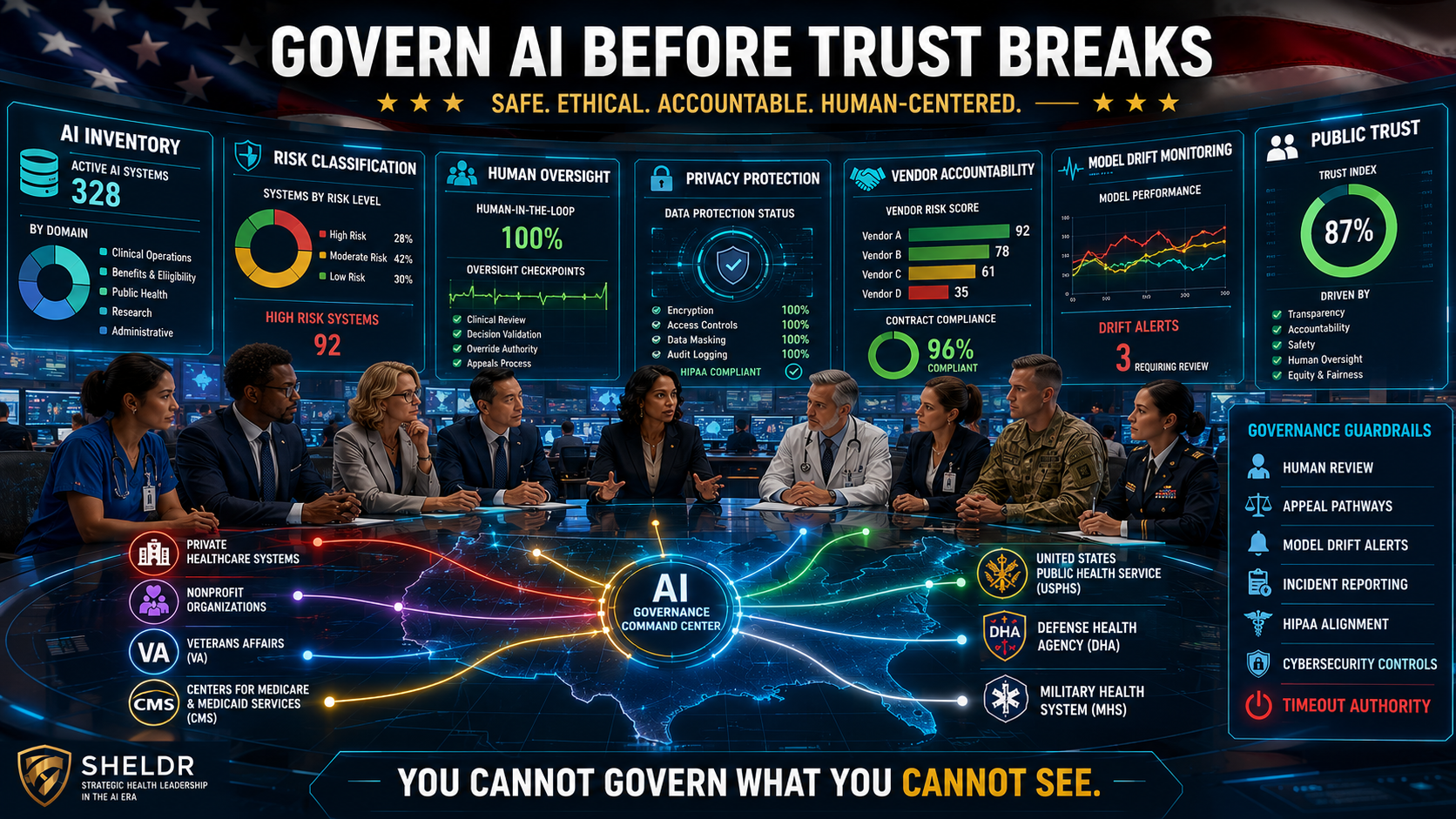
Many HHS organizations experiment first and govern later. That practice creates risk. AI-enabled strategic planning can affect resource allocation, access priorities, workforce deployment, and patient communication. Poorly governed systems can reinforce bad assumptions, miss local realities, or push leaders toward false confidence.
A 2025 JAMA Viewpoint on AI regulation emphasized the need for clear oversight as health AI expands. A 2024 NEJM AI article described AI as part of a health ecosystem, meaning leaders must monitor how tools interact with workflows, people, policy, and data. The table below gives leaders an operational governance checklist.
Table 3. Governance Controls for AI-Enhanced Strategy
| Control | Leadership Question | Failure Risk |
| Use-case approval | Should AI support this decision? | Misuse |
| Data review | Are inputs valid and current? | Bad forecasts |
| Human-in-the-loop authority | Who can override AI? | Blind automation |
| Monitoring | Does performance drift? | Hidden failure |
| Documentation | Can leaders explain the decision? | Weak accountability |
| Incident reporting | How do teams report harm or error? | Repeated mistakes |
Sources: Mello and Guha, 2025; Coiera and Fraile-Navarro, 2024; Angus, 2025.
Governance does not slow innovation when leaders design it well. Governance prevents avoidable failure. In the control tower, rules keep speed from turning into a collision.
AI strategy without governance is acceleration without brakes. The workforce must know how to use the radar.
AI Changes Leadership Competencies
HHS leaders need new skills. Technical literacy matters, but executive judgment matters more.
Leaders must understand enough about AI to ask hard questions. What data trained the system? What assumptions drive the recommendation? What risk level applies? Who validates outputs? What happens when AI conflicts with frontline experience?
This is no longer optional. AHA’s 2025 Report: Building and Implementing an Artificial Intelligence, noted that hospital and health system executives increasingly focus AI investment on patient access, revenue cycle management, and operational throughput. Those areas sit at the center of strategic performance. The table below translates that shift into leadership competencies.
Table 4. New Strategic Planning Competencies
| Competency | Plain Meaning | HHS Application |
| AI literacy | Understand basic capabilities and limits | Question vendor claims |
| Scenario discipline | Test possible futures | Prepare for demand surges |
| Data judgment | Assess source quality | Avoid false confidence |
| Governance command | Set decision rules | Protect patients and staff |
| Strategic communication | Explain choices clearly | Build workforce trust |
| Learning agility | Adjust as evidence changes | Improve execution faster |
Sources: American Hospital Association, 2025; NEJM AI, 2024; JAMA, 2025.
The old planner built a better binder. The AI-era leader builds a better operating rhythm. Leadership development must catch up with AI-enabled planning. The next failure will come from weak adoption discipline.
Emerging Issues
Artificial Intelligence is forcing HHS leaders to rethink how strategy forms, evolves, and adapts under pressure. The issue no longer centers on whether Artificial Intelligence accelerates planning. The issue centers on whether executive teams can govern accelerated decisions without weakening trust, accountability, workforce stability, or operational judgment.
Many organizations now move faster operationally than their governance structures can safely support. That mismatch creates risk across Veterans Affairs systems, Military Health System operations, Medicaid-serving hospitals, behavioral health networks, and public health agencies, as they respond to workforce shortages, reimbursement instability, and rising demand.
Health leaders need stronger evidence connecting Artificial Intelligence-supported planning to measurable operational outcomes. Faster strategic reviews mean little if patient access worsens, workforce fatigue rises, or readiness indicators decline.
A rural hospital struggling with nursing vacancies faces operational realities different from those of a large integrated delivery network deploying predictive staffing analytics across multiple regions. Likewise, a Veterans Affairs scheduling center using Artificial Intelligence-supported forecasting requires stronger governance oversight than a commercial health system piloting low-risk administrative automation.
The table below expands the original research questions into operational leadership concerns facing HHS organizations today.
Table 5. Emerging AI Strategic Planning Risks, Questions, and Operational Actions
| Strategic Research Questions | Why This Issue Matters Operationally | Real-World HHS Example | Leadership Actions Needed |
| How does Artificial Intelligence compress strategic decision cycles? | Annual reviews cannot keep pace with rapid operational disruption. | Veterans Affairs access teams are now forecasting appointment surges weekly rather than quarterly. | Measure decision quality, response speed, operational outcomes, and workforce effects. |
| Which planning functions must remain human-led? | Blind automation can distort executive judgment. | Military Health System readiness planning during contingency operations. | Establish mandatory human-in-the-loop checkpoints and escalation authority. |
| Does Artificial Intelligence improve measurable outcomes? | Faster planning alone does not improve mission performance. | Medicaid-serving hospitals are using predictive staffing tools during nursing shortages. | Tie every Artificial Intelligence use case to access, quality, readiness, workforce, and cost metrics. |
| Which governance models reduce strategic failure risk? | Weak oversight scales flawed assumptions faster. | Public health agencies are using predictive outbreak monitoring across jurisdictions. | Build executive governance councils before enterprise deployment. |
| What new competencies do HHS leaders require? | Artificial Intelligence raises leadership expectations significantly. | Health executives interpreting predictive analytics during operational crises. | Train leaders in Artificial Intelligence literacy, scenario analysis, systems thinking, and operational governance. |
| How does automation bias affect executive decisions? | Leaders may trust dashboards over frontline reality. | Behavioral health call centers are relying too heavily on predictive triage recommendations. | Require periodic human validation and frontline operational review. |
| What barriers slow the equitable adoption of Artificial Intelligence? | Smaller systems often lack infrastructure and expertise. | Rural hospitals are struggling to implement predictive analytics safely. | Develop scalable governance models and shared support partnerships. |
Sources: JAMA Network Open, NEJM AI, American Hospital Association, HealthIT.gov, Coalition for Health AI.
The unanswered issue should unsettle every executive team: will Artificial Intelligence strengthen strategic judgment, or merely make weak planning appear more sophisticated and technologically advanced?
Strong governance determines the difference between acceleration and operational instability. Executive teams must govern Artificial Intelligence before operational momentum overwhelms institutional judgment.
Why It Matters and What Leaders Should Do Next
HHS leaders should act now.
Build governance before scale. Train executives before procurement. Start with low-risk planning support. Measure outcomes. Preserve human-in-the-loop authority. Review assumptions weekly. Track drift. Document decisions. Teach teams how AI supports judgment without replacing it.
Use AI as radar, not autopilot.
Conclusion and Call to Action
Strategic planning should help people know what matters next. AI can strengthen that work by improving awareness, speed, forecasting, and monitoring.
But leaders still define purpose. Leaders still choose priorities. Leaders still carry accountability.
Do not let AI produce faster confusion.
Use it to shorten the distance between awareness, judgment, and action.
Learn more: 6 Powerful AI Deployment Strategies Health and Human Services (HHS) Leaders Must Adopt Now
Discussion Questions With Supporting Image
- Which strategic planning decisions in your organization must remain human-led?
- What governance controls should exist before AI supports executive decisions?
- How would your planning cycle change if leaders reviewed strategic signals weekly?
References
- Everson J, Adler-Milstein J, Holmgren AJ. Uptake of generative AI integrated with electronic health records in US hospitals. JAMA Netw Open. 2025. https://pmc.ncbi.nlm.nih.gov/articles/PMC12701511/
- Angus DC. AI, health, and health care today and tomorrow. JAMA. 2025. https://jamanetwork.com/journals/jama/fullarticle/2840175
- Wachter RM, Brynjolfsson E. Will generative AI deliver on its promise in health care? JAMA. 2024. https://jamanetwork.com/journals/jama/fullarticle/2812615
- Nong P, Wang A, Taylor DH Jr, et al. How academic medical centers govern AI prediction tools in clinical care. NEJM AI. 2024. https://ai.nejm.org/doi/abs/10.1056/AIp2300048
- Coiera E, Fraile-Navarro D. AI as an ecosystem: ensuring generative AI is safe and effective. NEJM AI. 2024;1(9). https://psnet.ahrq.gov/issue/ai-ecosystem-ensuring-generative-ai-safe-and-effective
- Balanced Scorecard Institute. Augmented strategy: the promise and pitfalls of AI in strategic planning. Published 2024. Accessed May 28, 2026. https://balancedscorecard.org/blog/augmented-strategy-the-promise-and-pitfalls-of-ai-in-strategic-planning/
- LBL Strategies. How might artificial intelligence impact strategic planning and management? Published 2024. Accessed May 28, 2026. https://www.lblstrategies.com/how-might-artificial-intelligence-impact-strategic-planning-and-management/
- Paradigm Associates. AI just blew up my strategic planning process. Published 2024. Accessed May 28, 2026. https://www.paradigmassociates.us/resources-tools/our-latest-thinking/ai-just-blew-up-my-strategic-planning-process
- OnStrategy. AI prompts for strategic planning and execution. Published 2024. Accessed May 28, 2026. https://onstrategyhq.com/resources/ai-prompt-strategic-plan/
- Bodell L. Your cheat sheet for using AI in strategic planning. Forbes. Published July 10, 2023. Accessed May 28, 2026. https://www.forbes.com/sites/lisabodell/2023/07/10/your-cheat-sheet-for-using-ai-in-strategic-planning/
- Sadun R, Hancock B, Schafer K. How CEOs are using generative AI for strategic planning. Harvard Business Review. Published September 2024. Accessed May 28, 2026. https://hbr.org/2024/09/how-ceos-are-using-gen-ai-for-strategic-planning
#ArtificialIntelligence #StrategicPlanning #HealthLeadership