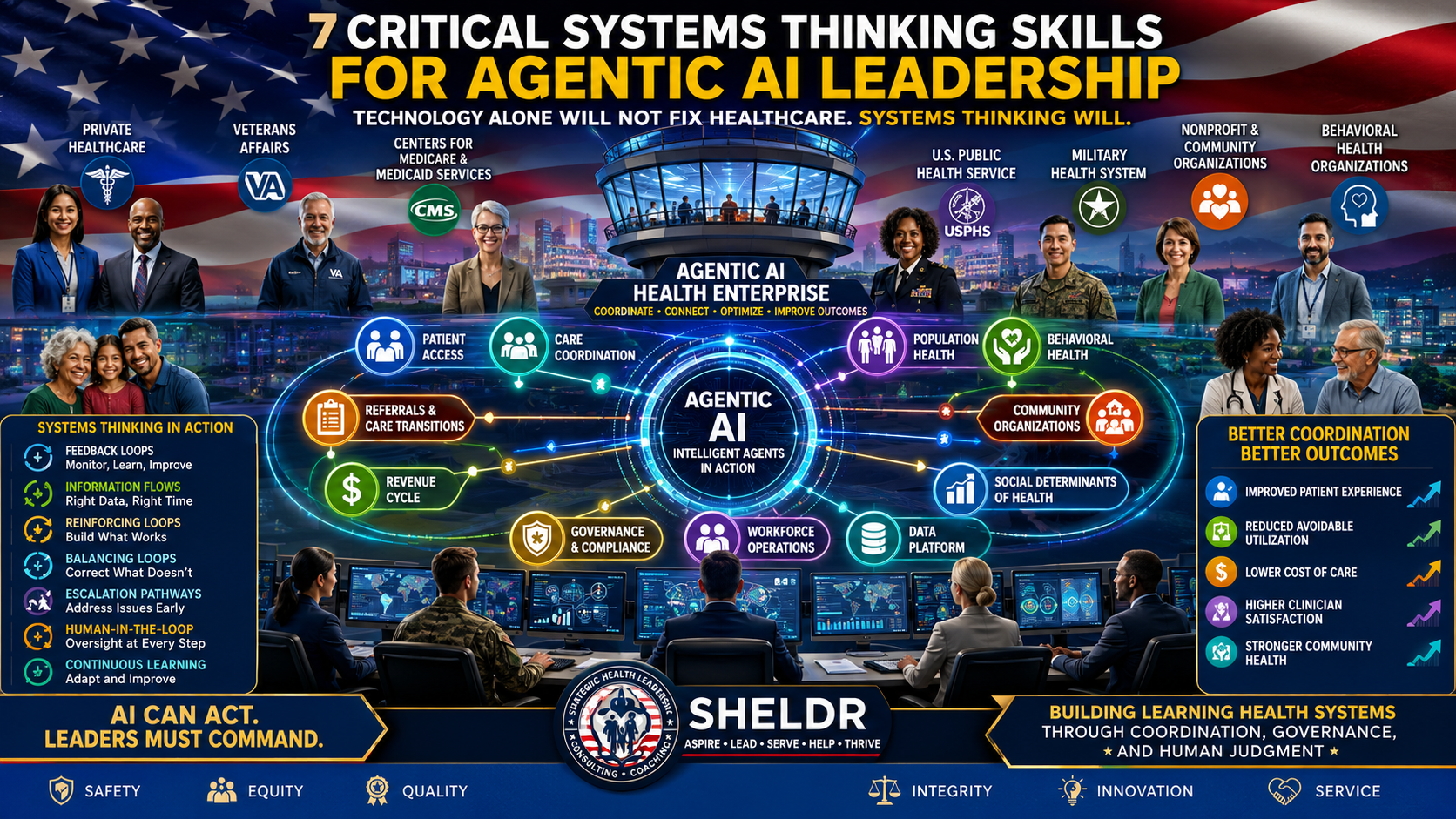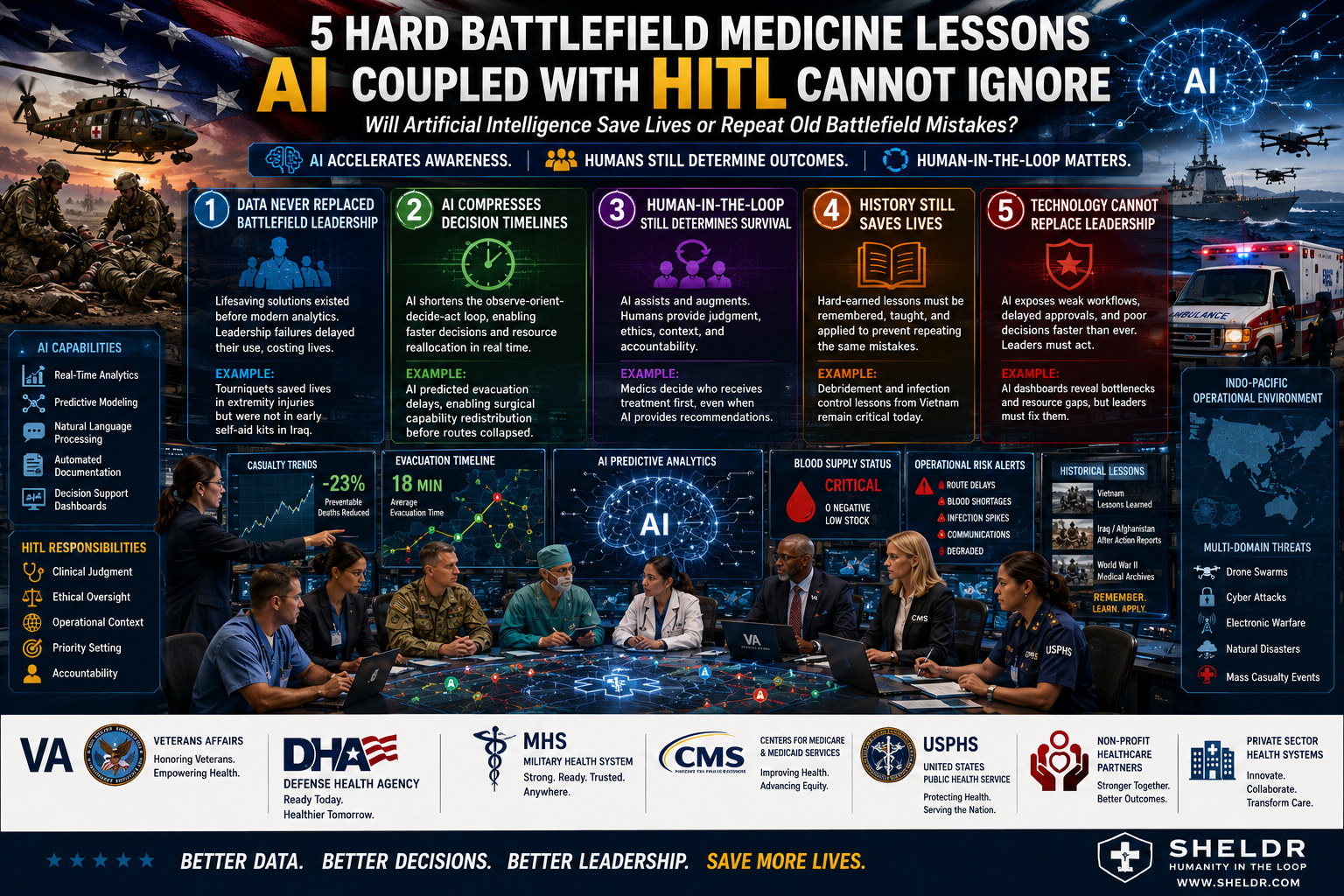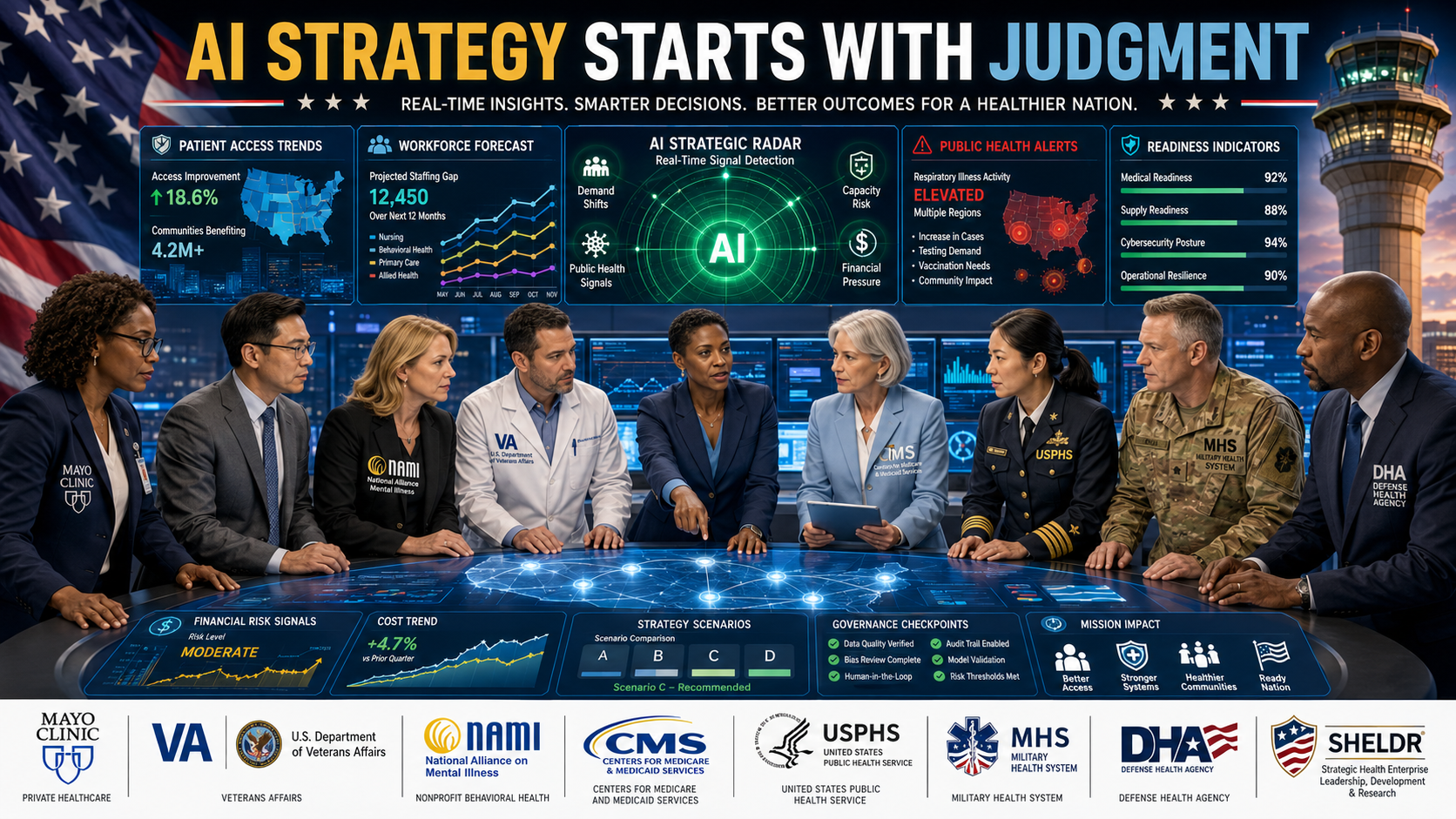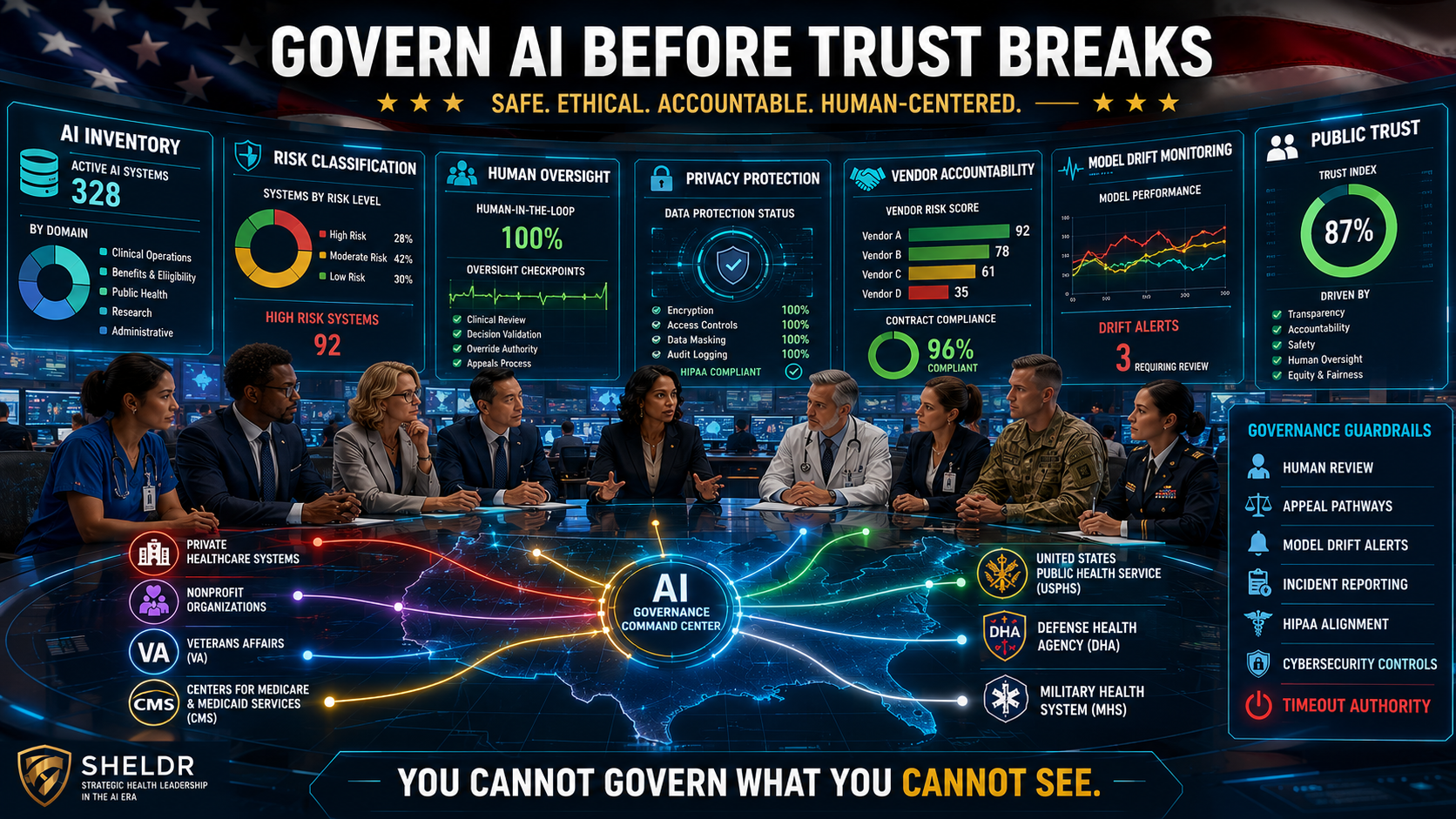
Can health leaders define tomorrow before AI accelerates change?
Executive Summary
Artificial Intelligence (AI) compresses planning cycles, accelerates execution, and magnifies leadership strengths and weaknesses. Strategic health leaders (SHELDR: www.sheldr.com) must define mission, governance, trust, and human judgment before AI scales operational complexity. Visioning now functions as a leadership survival skill across Health and Human Services organizations, navigating rapid technological disruption.
Introduction With Scenario
A senior executive team inside a large health system gathers to review multiple AI proposals. One tool predicts readmissions. Another automates prior authorization workflows. Another draft of documentation. Another analyzes workforce trends. Vendors promise speed, savings, and operational transformation. Yet one executive asks a question that stops the room: “What future are we actually building?” … Silence follows.
That silence defines the leadership challenge of the AI era. AI can generate options rapidly. Leaders still must decide which direction deserves trust, investment, governance, and operational commitment. This article explains why visioning, governance, strategic adaptability, and human judgment now determine whether AI strengthens or destabilizes healthcare organizations.
AI Demands Faster Strategic Health Leadership
Strategic health leadership means aligning mission, workforce, technology, operations, finance, and trust around measurable outcomes. Traditional leadership approaches depended heavily on static planning cycles, long forecasting windows, and slower operational change. AI disrupts that model completely.
Predictive AI use in U.S. hospitals increased from 66% in 2023 to 71% in 2024, according to HealthIT.gov. AI now touches reimbursement, documentation, clinical workflows, public health operations, scheduling, behavioral health triage, and decision support systems. The table below compares traditional strategic planning against artificial intelligence-era leadership expectations.
.
The table below moves beyond simple contrasts and shows how AI changes leadership tempo, governance demands, workforce expectations, operational design, and strategic accountability across Health and Human Services systems. The examples connect directly to real-world healthcare, Veterans Affairs, Centers for Medicare & Medicaid Services, Military Health System, behavioral health, and public health operations.
Table 1. Traditional Strategic Planning Versus AI-Era Health Leadership
| Traditional Leadership Model | AI-Era Strategic Health Leadership | Real-World HHS Example | Leadership Risk if Ignored |
| Five-year strategic plans are reviewed annually | Rolling strategy adaptation with continuous recalibration | Health systems revise workforce, reimbursement, and telehealth strategies quarterly as AI reshapes demand patterns | Static plans become obsolete before implementation |
| Slow retrospective data review | Real-time sensing and predictive operational awareness | Veterans Affairs crisis lines use AI-assisted monitoring to identify suicide-risk escalation patterns earlier | Leaders react too late to emerging threats |
| Department-level innovation pilots | Enterprise-wide coordination across clinical, operational, financial, and public health systems | Centers for Medicare & Medicaid Services integrates interoperability, prior authorization, and technology-enabled care initiatives across multiple domains. | Fragmented adoption creates workflow conflict. |
| Technology procurement focus | Mission-first governance and operational alignment | Defense Health Agency evaluates AI tools based on readiness, patient safety, and workforce trust before deployment | Organizations buy tools without solving mission problems |
| Annual policy revisions | Continuous governance updates and rapid oversight cycles | Hospitals continuously revise AI oversight policies as models drift or federal guidance changes | Governance gaps increase liability exposure |
| Human labor-centered workflows | Human-AI collaborative operating environments | Ambient documentation tools reduce clinician administrative burden while preserving physician review authority. | Workforce resistance and burnout increase |
| Reactive staffing decisions | Predictive workforce intelligence and dynamic resource allocation | Public health leaders forecast staffing shortages and behavioral health demand spikes before an operational breakdown occurs | Staffing instability weakens care delivery |
| Manual utilization management | AI-supported workflow orchestration and prioritization | Prior authorization systems route urgent clinical cases faster using intelligent triage models | Delayed care and operational bottlenecks persist |
| Isolated decision-making | Integrated command-center leadership models | Health systems combine clinical, operational, cybersecurity, financial, and public health intelligence into unified dashboards. | Leaders operate with incomplete situational awareness. |
| Compliance-focused oversight | Trust-centered governance with explainability and human override authority | Organizations establish clinician TIMEOUT AUTHORITY to pause unsafe AI recommendations | Blind automation weakens trust and patient safety |
Sources Used to Build Table: HHS AI Strategy; CMS Responsible AI Guidance; ONC HealthIT Predictive AI Trends Report; VA AI Strategy; Defense Health Agency Responsible AI initiatives.
The old leadership model assumed stability. AI destroys stability by accelerating information flow, decision speed, and operational expectations. Strategic leadership now requires leaders to sense, interpret, decide, and adapt continuously. AI accelerates organizational tempo. Leaders who cannot create clarity quickly risk scaling confusion rather than progress.
The next issue involves vision itself.
Visioning Now Drives Healthcare AI Direction
Visioning now functions as an operational leadership competency across Health and Human Services systems. AI accelerates planning, forecasting, staffing, reimbursement, and clinical workflows so rapidly that leaders must define direction before deployment scales confusion, distrust, or operational instability.
Strong visioning transforms uncertainty into coordinated action. Clinicians, analysts, executives, behavioral health teams, public health officers, and frontline personnel need a shared understanding of mission priorities, governance boundaries, workforce expectations, and human accountability before AI reshapes operations.
The table below expands the core visioning questions strategic health leaders should answer before scaling enterprise AI initiatives.
Table 2. Core Visioning Questions for AI-Era Health Leaders
| Leadership Question | Strategic Purpose | Real-World HHS Example | Leadership Risk if Ignored |
| What future are we building? | Defines mission direction and operational priorities | A health system aligns AI investments toward reducing clinician burnout and improving patient access | Technology expansion without a measurable purpose |
| What decisions must remain human? | Protects clinical judgment and ethical accountability | Physicians retain override authority during high-risk clinical decisions | Blind automation weakens trust |
| What risks deserve refusal? | Establishes operational safety boundaries | Veterans Affairs leaders pause unsafe behavioral health triage models | Unsafe deployment scales rapidly |
| What governance protects trust? | Builds transparency and workforce confidence | CMS requires explainability and auditability for AI-supported workflows | Governance gaps increase liability |
| What outcomes prove value? | Prevents vanity metrics and technology hype | Hospitals measure readmissions, delays, workforce burden, and patient safety outcomes. | Leaders mistake activity for progress |
| Who owns accountability? | Clarifies oversight and escalation authority | Defense Health Agency assigns named operational AI leaders | Confusion delays response during failures |
Sources: HHS AI Strategy; CMS Responsible AI Guidance.
AI lowers execution costs but increases leadership responsibility. Organizations that define mission, accountability, governance, and trust before deployment gain a strategic advantage faster than organizations chasing disconnected pilots or vendor promises. Visioning now determines whether AI strengthens operations or accelerates fragmentation across healthcare delivery systems.
AI lowers the cost of execution. That increases the value of clarity, discipline, and judgment. Visioning now functions as operational infrastructure. Leaders who fail to define mission and boundaries before deployment risk accelerating fragmentation, distrust, and governance failures.
The operational cycle itself also changes dramatically.
The next challenge involves compressing leadership tempo through AI-enabled acceleration of the OODA cycle.
AI Accelerates Healthcare Leadership Decision Cycles
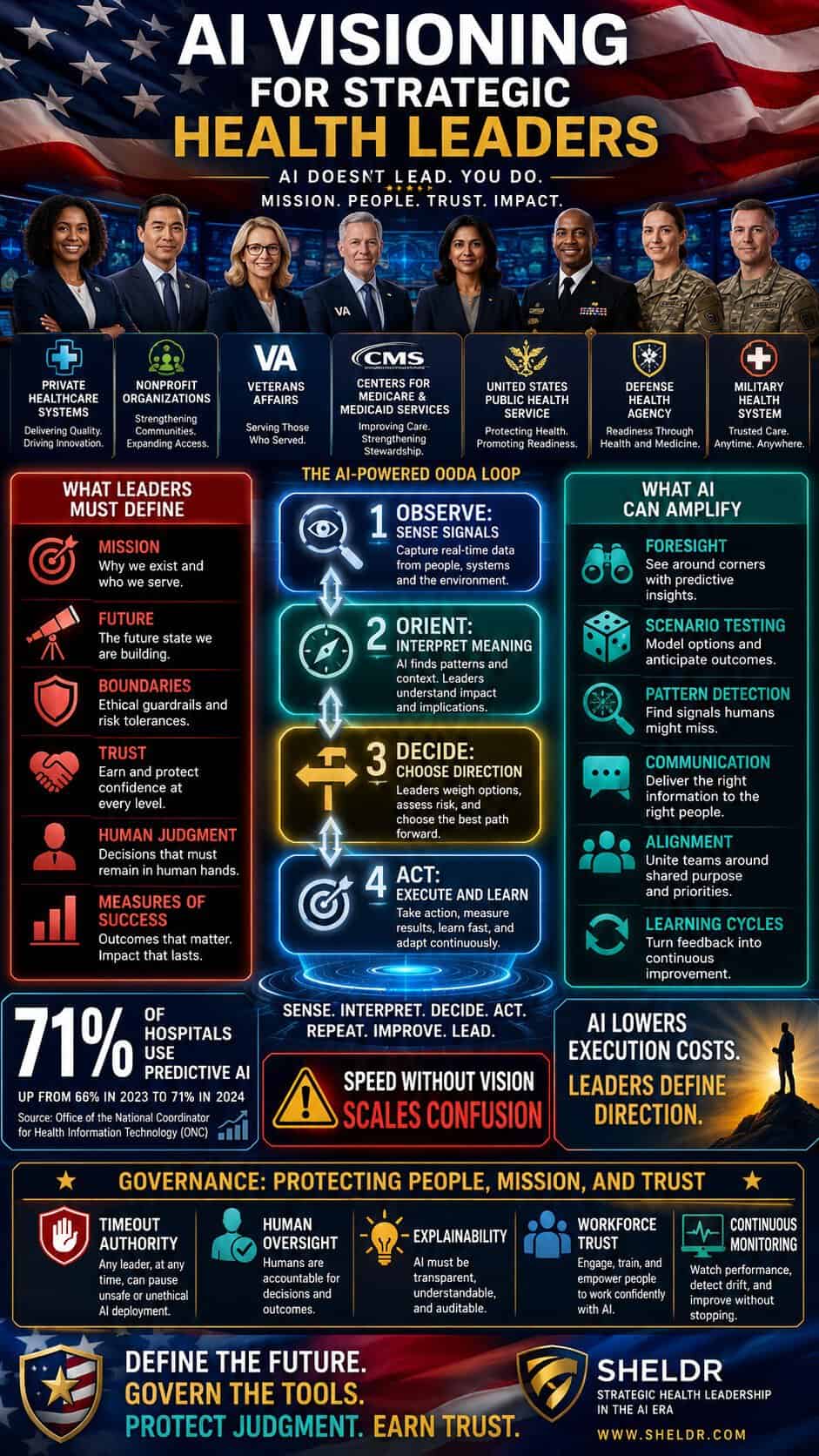
Military strategists use the OODA loop to describe competitive decision cycles: Observe, Orient, Decide, and Act. AI compresses each stage of that cycle across Health and Human Services operations. Predictive analytics, continuous sensing tools, and real-time monitoring platforms help organizations detect operational, clinical, financial, and workforce signals much faster than traditional reporting methods.
Machine learning systems strengthen orientation by identifying patterns, mapping dependencies, and uncovering emerging risks hidden inside large clinical and operational datasets. Scenario-modeling tools support leaders during decision-making by comparing strategic options, forecasting consequences, and stress-testing assumptions before implementation begins. Automated workflows, intelligent communication systems, and dynamic resource-allocation platforms accelerate execution once leaders choose a direction.
In practical terms, AI can help a hospital identify rising readmission risks earlier, assist a Veterans Affairs crisis line in prioritizing urgent calls faster, support Centers for Medicare & Medicaid Services prior authorization workflows more efficiently, and help public health leaders detect emerging threats sooner.
The real advantage is not speed alone. The advantage comes from compressing the time between sensing a problem and acting responsibly. A fighter pilot gains an advantage by shortening the gap between detection and response. Strategic health leaders gain the same advantage when AI strengthens operational awareness, improves decision discipline, and accelerates coordinated action without weakening human judgment.
The table below expands the OODA framework into operational examples in Health and Human Services. It shows where AI accelerates sensing, interpretation, coordination, forecasting, communication, and execution while preserving human accountability. The examples connect strategic leadership directly to healthcare delivery, Veterans Affairs operations, Military Health System readiness, behavioral health response, reimbursement workflows, and public health coordination.
Table 3. How AI Compresses the OODA Loop in Health and Human Services
| OODA Phase | AI Capability | Strategic Health Leadership Function | Healthcare and HHS Example | Human Responsibility |
| Observe | Predictive analytics, continuous monitoring, real-time sensing, anomaly detection | Detect emerging risks, operational gaps, workforce strain, utilization spikes, and patient safety concerns earlier. | AI identifies rising emergency department boarding times, suicide-risk escalation patterns, abnormal claims activity, or infectious disease spikes. | Leaders decide which signals deserve immediate action |
| Orient | Pattern recognition, dependency mapping, scenario analysis, trend comparison | Interpret operational meaning and connect clinical, financial, workforce, and public health impacts. | AI correlates staffing shortages with readmissions, delayed prior authorizations, or Veterans Affairs appointment backlogs. | Leaders determine operational relevance and mission impact |
| Decide | Forecasting, simulation modeling, decision support, option comparison | Evaluate tradeoffs, compare strategic options, prioritize resources, and estimate consequences | AI simulates effects of expanding telehealth, reallocating behavioral health staff, or modifying Military Health System readiness workflows | Leaders choose direction, risk tolerance, and accountability |
| Act | Workflow automation, intelligent routing, adaptive communication, resource optimization | Accelerate execution, coordination, communication, and operational response. | AI automates prior authorization routing, supports crisis-line triage, accelerates discharge planning, or updates public health alerts. | Leaders monitor outcomes and intervene when systems drift |
| Learn and Adapt | Feedback analysis, performance monitoring, drift detection, and after-action summaries | Improve strategy continuously and refine operational execution | AI detects declining model performance, workflow bottlenecks, or widening disparities across patient populations | Leaders revise policy, governance, staffing, and strategy |
Sources Used to Build Table: HHS AI Strategy; CMS Responsible AI Guidance; VA AI Strategy; ONC HealthIT Predictive AI Trends; Defense Health Agency Responsible AI initiatives.
A faster loop creates a strategic advantage only when there is leadership clarity. Faster confusion still produces failure.
AI compresses planning and execution cycles across the Health and Human Services. Leaders must strengthen judgment, governance, and operational discipline before acceleration outpaces organizational trust. Governance becomes the stabilizing force.
AI Governance Protects Organizational Trust
Governance now determines whether AI strengthens trust or accelerates operational failure across Health and Human Services systems. Federal guidance from HHS, the Centers for Medicare & Medicaid Services, the Veterans Affairs Department, and the Department of Defense increasingly emphasizes privacy, accountability, explainability, oversight, safety, and human responsibility in enterprise AI deployment.
Strong governance behaves like an aircraft command-and-control system. Pilots trust advanced aircraft because clear procedures, oversight chains, monitoring systems, and emergency controls are in place before takeoff. Healthcare leaders must apply identical operational discipline before scaling AI into patient care and workforce operations.
The table below outlines governance capabilities leaders should operationalize before enterprise deployment expands across clinical, operational, behavioral health, reimbursement, and public health environments.
Table 4. Governance Capabilities for AI-Era Health Leadership
| Governance Area | Leadership Requirement | Real-World HHS Example | Risk if Weak |
| Oversight | Named operational accountability leaders | Veterans Affairs assigns responsible AI review authorities | Delayed response during failures |
| Privacy | Protection of personally identifiable and protected health information | CMS restricts unsafe generative AI data handling | Regulatory violations and trust erosion |
| Explainability | Transparent reasoning visibility | Clinicians review AI-generated risk factors before action | Black-box distrust |
| Workforce Trust | Continuous training and communication | Hospitals train staff on safe AI-assisted documentation | Workforce resistance |
| Refusal Authority | Power to pause unsafe deployment | Behavioral health leaders suspend harmful triage models | Unsafe automation scaling |
| Monitoring | Continuous drift and performance review | Defense Health Agency monitors AI-supported readiness systems | Hidden operational degradation |
Sources: CMS Responsible AI Guidance; VA AI Strategy; HHS AI Strategy.
Governance protects organizational trust during acceleration. Leaders who operationalize accountability, transparency, monitoring, and refusal authority before deployment create safer adoption pathways than organizations chasing speed without discipline or oversight structures. Strong governance also strengthens workforce confidence, patient trust, and executive decision-making during rapid operational change.
The next leadership challenge involves balancing execution speed against workforce trust and human judgment. One emerging issue deserves stronger discussion: refusal authority. Organizations need operational mechanisms to pause AI deployment when safety, trust, bias, or governance risks outweigh the value. Governance does not slow innovation. Strong governance protects trust, strengthens adoption, and prevents operational chaos during rapid AI expansion.
Emerging AI Leadership Risks Leaders Ignore
Several leadership gaps now deserve urgent attention across Health and Human Services systems. AI compresses planning cycles, accelerates operational tempo, and magnifies weak governance faster than many organizations can adapt. Leaders who continue to rely on static planning models, fragmented oversight, or outdated workforce assumptions risk scaling confusion rather than strategic advantage.
The next phase of strategic health leadership requires new operational disciplines, stronger governance structures, and more deliberate workforce preparation. The table below outlines emerging leadership capabilities organizations should strengthen before AI reshapes healthcare operations faster than leaders can govern them.
Table 5. Emerging Leadership Capabilities in the AI Era
| Emerging Leadership Topic | Why It Matters | Real-World HHS Example | Leadership Risk if Ignored |
| AI-enabled rolling strategy cycles | AI changes operational conditions continuously | Hospitals revise staffing, reimbursement, and telehealth strategies quarterly rather than every 5 years. | Strategic plans become obsolete rapidly |
| Workforce trust measurement | Distrust blocks adoption and increases override behavior | Clinicians reject poorly explained documentation tools | Technology investments fail operationally |
| Executive vision drills | Leaders need practice navigating AI-enabled disruption | Public health leaders simulate outbreak-response coordination using AI-supported forecasting | Executives freeze during rapid change |
| Operational refusal authority | Unsafe systems require a rapid intervention authority | Behavioral health leaders pause harmful triage algorithms | Unsafe automation scales unchecked |
| Human-retained decision mapping | Leaders must define which decisions remain human-led | Physicians maintain override authority during high-risk treatment decisions | Blind automation weakens accountability |
| Strategic foresight training | Leaders must anticipate second-order consequences earlier | Veterans Affairs executives model workforce, claims, and access impacts before deployment | Leaders react instead of anticipate |
Sources: HHS Artificial Intelligence Strategy, Trust — The Invisible Infrastructure of AI Transformation, The Emerging Leadership Development Gap of the AI Era
The most provocative issue is this: AI increases the value of lived experience. Data supports decisions, but algorithms cannot replace judgment forged through bedside care, crisis response, public health emergencies, claims operations, military medicine, or community leadership. Strong leaders convert AI into a strategic advantage by combining faster sensing with disciplined judgment, operational trust, and governance maturity.
Health leaders should define AI-era mission priorities, establish enterprise governance structures, shift toward rolling strategic reviews, strengthen foresight training, define human-retained decisions, and use AI to improve strategic clarity rather than automate leadership responsibility.
AI Intensifies Strategic Health Leadership Responsibility
AI will not eliminate leadership responsibility across the Health and Human Services. It intensifies leadership demands by accelerating decision cycles, operational tempo, workforce expectations, and organizational risk simultaneously. Faster systems magnify both disciplined leadership and operational weakness.
The future belongs to leaders who can define mission, govern acceleration, protect workforce trust, preserve human judgment, and create organizational clarity before AI scales confusion across clinical, operational, reimbursement, behavioral health, and public health environments.
A mission commander does not surrender control to advanced aircraft systems during turbulence. The commander uses technology as a force multiplier guided by training, experience, oversight, accountability, and disciplined judgment. Strategic health leaders must approach AI the same way.
The central question remains unavoidable: What future are you intentionally building before AI accelerates its operational, cultural, financial, and clinical impact across your organization?
Learn more: Brutal AI Truths Health Leaders Must Recognize
Cool Image and Discussion Questions
- Which strategic decisions inside your organization must remain human-led?
- How can AI strengthen visioning without weakening accountability?
- Where does your organization need stronger refusal authority before scaling artificial intelligence?
References
- Office of the National Coordinator for Health Information Technology. Hospital Trends in Use, Evaluation, and Governance of Predictive AI, 2023-2024. HealthIT.gov. Published 2025. https://healthit.gov/data/data-briefs/hospital-trends-use-evaluation-and-governance-predictive-ai-2023-2024/
- U.S. Department of Health and Human Services. AI Strategy. Published 2025. https://www.hhs.gov/sites/default/files/hhs-artificial-intelligence-strategy.pdf
- Centers for Medicare & Medicaid Services. Guidance for Responsible Use of AI at CMS. Published 2026. https://security.cms.gov/policy-guidance/guidance-responsible-use-artificial-intelligence-ai-cms
- U.S. Department of Veterans Affairs. Building the Future: VA’s Strategy for Adopting High-Impact AI to Improve Services for Veterans. Published 2026. https://department.va.gov/ai/building-the-future-vas-strategy-for-adopting-high-impact-artificial-intelligence-to-improve-services-for-veterans/
- Ayers JW, Poliak A, Dredze M, et al. Comparing Physician and AI Chatbot Responses to Patient Questions. JAMA Intern Med. 2023;183(6):589-596. https://jamanetwork.com/journals/jamainternalmedicine/fullarticle/2804309
#ArtificialIntelligence #HealthLeadership #StrategicLeadership