Will Artificial Intelligence Save Lives or Repeat Old Battlefield Mistakes?
Executive Summary
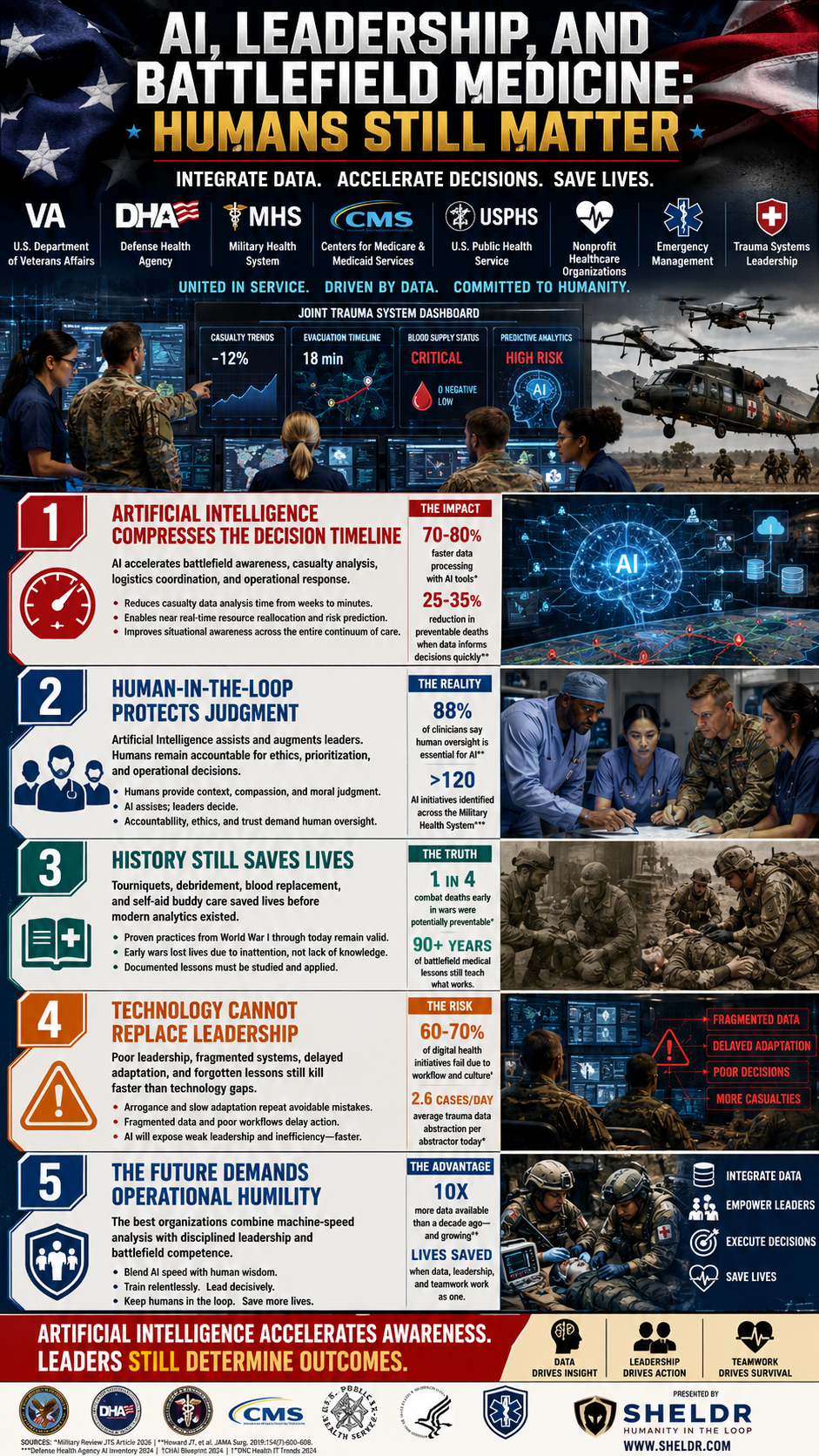
Artificial Intelligence (AI) is rapidly changing military and civilian Health and Human Services (HHS) systems. The Joint Trauma System (JTS) demonstrates how data integration, operational medicine, and leadership accelerate battlefield survival. AI can dramatically compress research and analysis timelines. Human judgment still determines outcomes. History shows that poor leadership, forgotten lessons, and delayed operational adaptation kill faster than technology gaps. Human-In-The-Loop (HITL) leadership remains essential in the emerging AI era.
AI Collides with Battlefield Reality
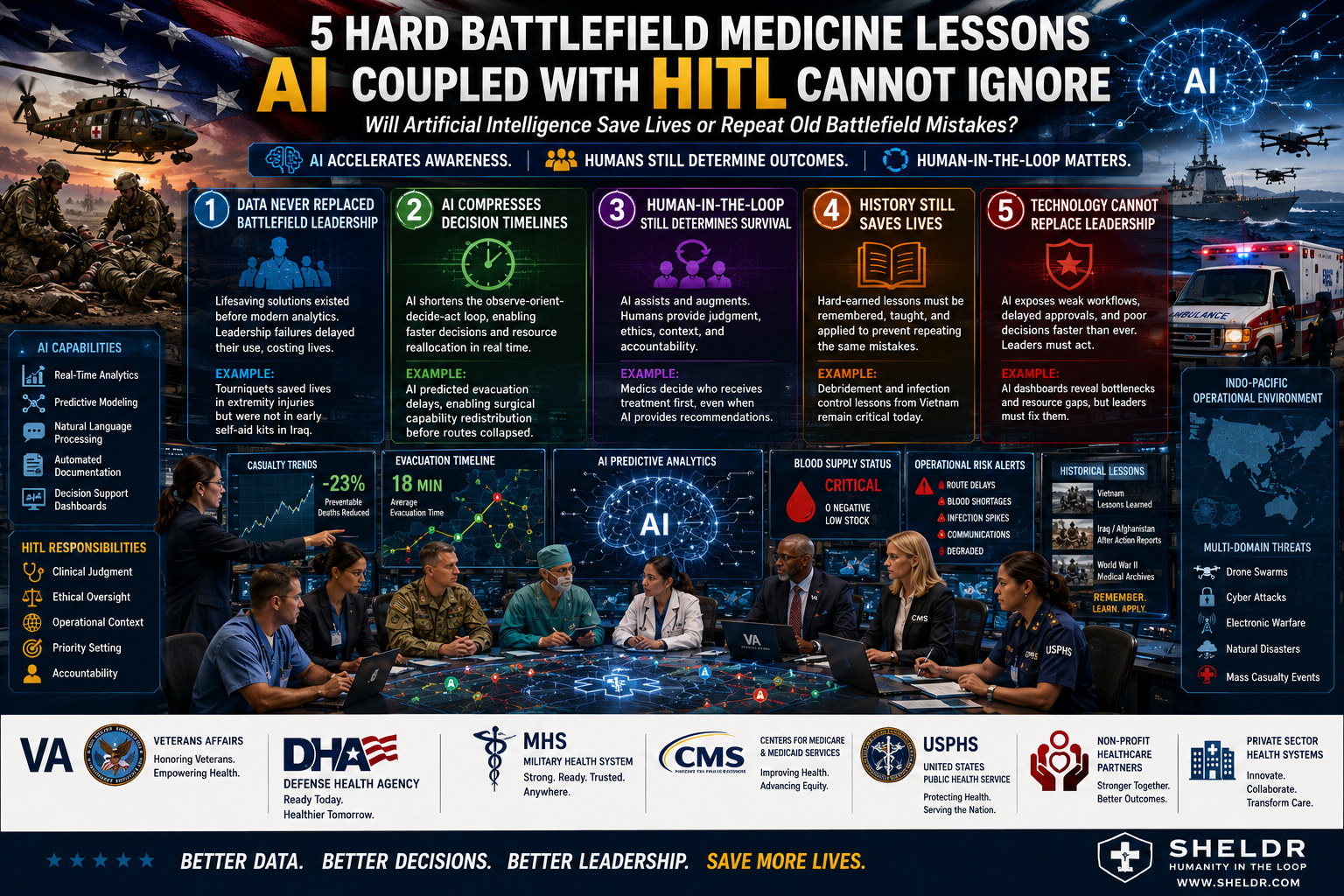
A medic kneels beside three wounded warfighters during a drone-saturated Indo-Pacific conflict. Communications fail. Evacuation delays grow. Blood supplies shrink. A cloud-enabled trauma platform projects casualty deterioration patterns in near real time. The medic still decides who receives treatment first. Technology accelerates awareness. Leadership still determines survival.
Machine-speed analysis now collides directly with battlefield judgment under pressure.
That scenario captures the future of military medicine and civilian emergency response. AI will dramatically compress the observe-orient-decide-act loop. AI will not replace leadership, operational discipline, or battlefield judgment.
Technology accelerates action when leaders remember history and execute fundamentals.
Data Never Replaced Battlefield Leadership
Early Iraq and Afghanistan casualties exposed a painful operational truth. Battlefield medicine already possessed many lifesaving solutions before modern analytics emerged. Tourniquets, infection control, debridement, and blood replacement were in use long before cloud computing or predictive dashboards entered military medicine. Leaders failed faster than technology evolved.
According to Gurney and Miller, fragmented battlefield trauma systems delayed lifesaving adaptation during early combat operations. The article “Saving Lives with Data” correctly argues that integrated trauma systems reduce preventable battlefield deaths. The Joint Trauma System (JTS) integrated casualty care data, operational medicine, logistics, and doctrine across the Global War on Terrorism (GWOT). The system improved survivability significantly. To paraphrase Howard and colleagues, integrated combat casualty data reduced preventable battlefield mortality significantly during prolonged conflicts.
Still, many colleagues challenge the assumption that technology alone transforms battlefield survival, reminding everyone of an uncomfortable truth often ignored in modern AI discussions.
Many early Iraq and Afghanistan deaths did not occur because leaders lacked advanced analytics. Leaders ignored known lessons from prior wars. Tourniquets already worked. Debridement already worked. Infection control already worked. Self-aid buddy care already worked. Battlefield blood replacement already worked. Experienced trauma surgeons and operational clinicians knew these lessons from Vietnam, Somalia, Korea, and World War II. The military failed to operationalize them early enough.
That distinction fundamentally changes the Artificial Intelligence discussion. Machine-speed analytics can identify trends rapidly, but predictive systems cannot overcome institutional arrogance, delayed command approval, weak doctrine dissemination, or poor workflow integration. The Indo-Pacific battlefield scenario illustrates this perfectly. AI-enabled dashboards may identify evacuation collapse within minutes. Medics still require approved protocols, available blood products, trained personnel, and command authority to act immediately.
The analogy is like a fighter aircraft’s cockpit warning system. Sensors identify danger instantly. Pilots still execute disciplined responses under extreme pressure.
Recent Defense Health Agency reporting identified more than 120 Artificial Intelligence initiatives across the Military Health System. Simultaneously, operational modernization programs continue to develop the SIMON trauma platform to improve near-real-time battlefield awareness. Those systems matter operationally because large-scale combat operations will rapidly overwhelm current manual abstraction processes.
The operational framework below demonstrates how leadership failures repeatedly delayed known lifesaving interventions across previous conflicts.
Table 1. Battlefield Lessons Already Known Before AI
| Historical Battlefield Problem | Known Solution Before Conflict | Operational Failure | AI Potential Contribution | HITL Requirement |
| Extremity hemorrhage deaths | Tourniquets | Delayed fielding and training | Faster casualty trend detection | Command approval and medic execution |
| Infection-related deaths | Debridement and sterile practices | Inconsistent enforcement | Rapid infection surveillance | Surgical discipline |
| Delayed evacuation stabilization | Blood replacement and forward care | Resource allocation delays | Predictive logistics modeling | Operational prioritization |
| Fragmented lessons learned | Published historical records | Institutional turnover | Historical pattern retrieval | Leadership study and doctrine updates |
Sources: Joint Trauma System article
Artificial Intelligence did not invent the fundamentals of battlefield medicine. Predictive systems reinforce, accelerate, and operationalize lessons already learned through combat experience. Leadership, operational discipline, and institutional humility still determine whether organizations apply lifesaving interventions before casualties escalate unnecessarily.
Historical memory now competes against operational tempo and machine-speed battlefield analytics.
AI Compresses Operational Decision Timelines
The article describes a battlefield medical ecosystem drowning in fragmented documentation, handwritten notes, PDFs, disconnected systems, and delayed abstraction processes. Current Joint Trauma System abstraction rates average only 1.7 to 2.6 cases per day per abstractor. During large-scale combat operations, the system could require 600-900 trained abstractors to avoid a catastrophic backlog.
That model collapses immediately during high-volume combat.
Artificial Intelligence changes the equation fundamentally. Natural language processing, optical character recognition, machine learning, and cloud-enabled data fabrics can extract operational insights from battlefield records within minutes rather than months.
The implications extend far beyond military medicine. Civilian HHS systems face identical operational friction:
- Fragmented electronic health records,
- Delayed claims analysis,
- Disconnected public health systems,
- Workforce shortages,
- And slow crisis-response coordination.
AI compresses operational latency. Imagine a hurricane striking the Gulf Coast. AI-enabled HHS platforms could identify emergency department surges, blood shortages, dialysis disruptions, behavioral health spikes, and evacuation bottlenecks in near real time. Health leaders could reposition resources before systems collapse. That capability mirrors the future battlefield trauma environment described in the article.
The table below focuses on the strategic shift occurring across HHS systems. AI increasingly functions as an operational command-and-control accelerator.
Table 2. AI Compression of the Operational Analysis Timeline
| Current Process | Traditional Timeline | AI-Enabled Timeline | Operational Benefit |
| Casualty abstraction | Weeks to months | Minutes to hours | Faster doctrine adaptation |
| Resource allocation analysis | Days | Near real-time | Improved survivability |
| Literature review synthesis | Months | Hours | Faster clinical updates |
| Public health surveillance | Delayed reporting | Continuous monitoring | Earlier intervention |
| Evacuation coordination | Fragmented communications | Integrated dashboards | Reduced mortality |
Sources: Military Review JTS article; Defense Health Agency AI modernization efforts; HHS digital transformation trends.
Artificial Intelligence collapses information friction across battlefield medicine and civilian HHS operations. Faster analysis improves operational awareness, but only disciplined leadership converts insight into lifesaving action. Faster information increases risk when judgment and discipline decline simultaneously.
Human-In-The-Loop Still Determines Survival
Many colleagues’ warnings may be the most important lesson in the discussion. Military medicine repeatedly forgets its own history. Experienced leaders retire. Lessons disappear into classified systems. Younger professionals inherit fragmented knowledge and relearn avoidable failures in combat. Artificial Intelligence will not automatically solve institutional forgetting.
AI can retrieve historical lessons faster. AI can summarize archives, identify recurring patterns of casualties, and flag operational similarities across conflicts. AI still lacks operational wisdom, ethical judgment, emotional Intelligence, and battlefield context. That reality explains why Human-In-The-Loop (HITL) remains essential.
The future drone battlefield intensifies this requirement. Medics operating under autonomous surveillance, degraded communications, and contested evacuation routes will face decisions no algorithm can fully contextualize.
AI can recommend. Humans remain accountable.
The analogy resembles modern intensive care units. AI monitoring systems can detect physiologic deterioration earlier than clinicians alone. Experienced nurses and physicians still determine whether the alert reflects true danger, equipment failure, operational noise, or competing priorities. The same principle applies across HHS.
Recent surveys show that clinicians increasingly express concern about algorithmic bias, automation overreach, and the loss of professional autonomy in healthcare decision-making. Meanwhile, HHS organizations continue accelerating AI deployment across administrative, clinical, and operational workflows.
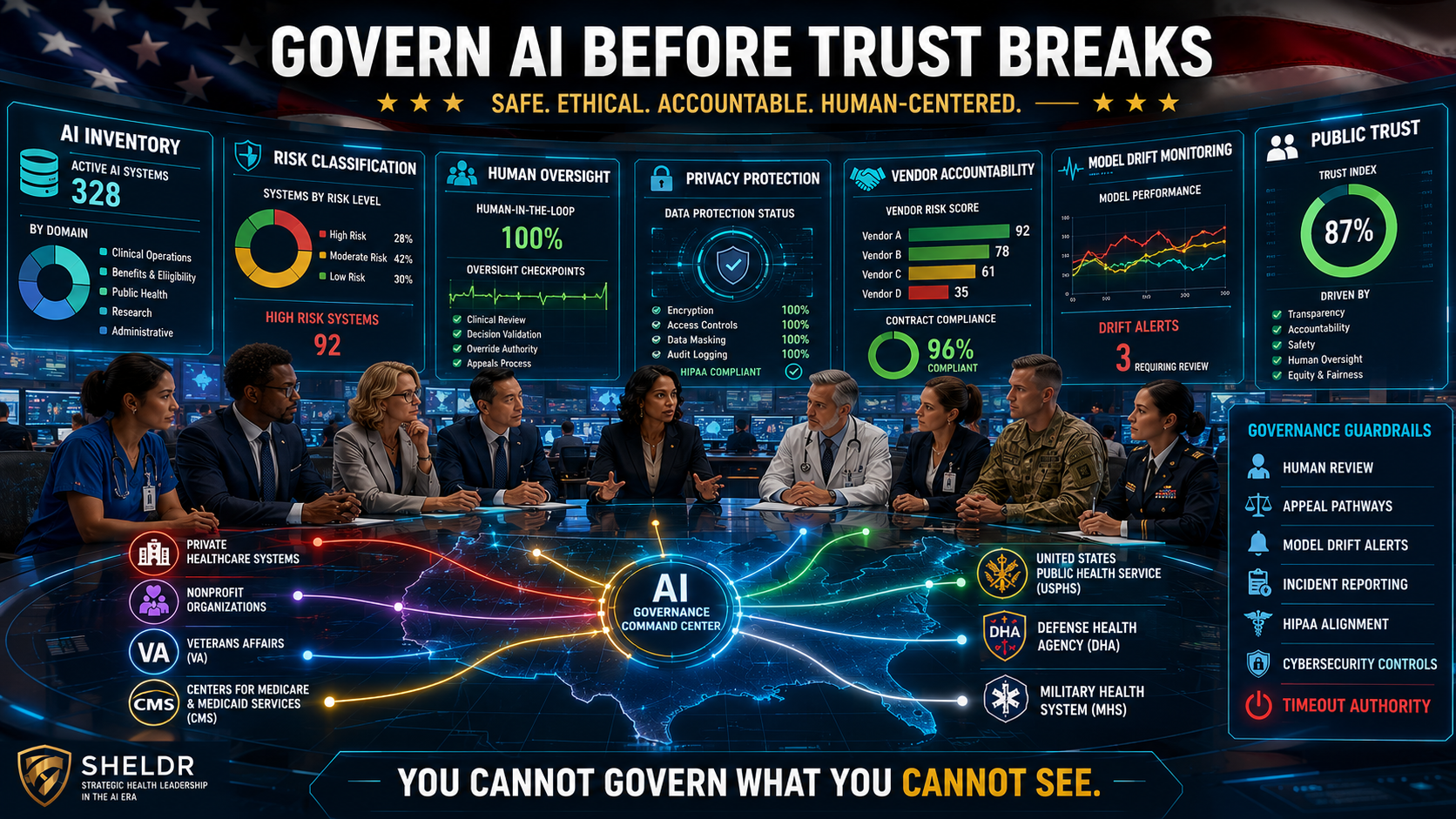
The risk is not insufficient technology or overconfidence. As stated by the National Institute of Standards and Technology, AI governance requires continuous human oversight during high-risk operational decisions. The table service serves as a reminder of these operational principles. AI functions best when integrated into disciplined workflows guided by experienced leaders.
Table 3. Human-In-The-Loop Responsibilities in the AI Era
| AI Capability | AI Limitation | HITL Responsibility |
| Pattern recognition | Lacks contextual judgment | Validate operational relevance |
| Predictive analytics | Cannot fully assess ethics | Apply moral accountability |
| Automated summarization | May hallucinate or distort | Verify accuracy |
| Operational forecasting | Limited battlefield intuition | Integrate commander’s intent |
| Historical retrieval | Cannot prioritize experience | Translate lessons into action |
Sources: Joint Trauma System article; AMA AI augmentation guidance; HHS operational governance principles.
Human-In-The-Loop protects organizations from technological arrogance, operational blindness, and overreliance on automation during high-pressure decision-making environments. And as a reminder, according to the American Medical Association, augmented Intelligence should assist clinicians rather than replace them. Future HHS leaders must combine operational humility with machine-speed awareness.
Emerging AI Risks Health Leaders Ignore
A drone swarm turns off satellite communications across a Pacific operational corridor. Casualties surge simultaneously across military and civilian hospitals. Predictive dashboards fail intermittently. Conflicting operational reports flood command centers. Artificial Intelligence recommendations begin diverging from frontline realities. Experienced leaders suddenly become the last operational safeguard.
AI promises faster decisions across military and civilian Health and Human Services systems. The same machine-speed environment also introduces operational risks that many leaders still underestimate. The Indo-Pacific battlefield scenario demonstrates how degraded communications, misinformation, fragmented governance, and overreliance on automation could rapidly overwhelm decision-making during high-pressure operations.
Leadership accountability remains the most overlooked vulnerability. Predictive systems increasingly expose inefficient workflows, delayed approvals, fragmented command structures, and poor operational coordination. Organizations resistant to transparency or operational adaptation may experience system-wide failure faster than in previous crises.
The operational matrix below highlights emerging risks already appearing across military medicine, emergency management, and civilian healthcare systems. These threats extend beyond technology failures alone. Most risks emerge when leaders fail to integrate Human-In-The-Loop oversight into operational workflows.
Before reviewing the framework below, remember the aviation analogy sustained throughout this article. Advanced cockpit systems dramatically improve pilot awareness. Pilots still crash aircraft when discipline, communication, or judgment collapses under pressure.
Table 4. Emerging Artificial Intelligence Risks Across Operational Health Systems
| Emerging AI Risk | Real-World Operational Example | Potential Operational Consequence | Human-In-The-Loop Requirement | Recommended Leader Action |
| Degraded communications during conflict | Drone or cyber disruption of battlefield networks | Delayed casualty coordination and evacuation failures | Manual operational verification | Maintain redundant communication workflows |
| Autonomous triage overreliance | AI prioritizes casualties incorrectly during a mass-casualty event | Preventable mortality increases | Clinician override authority | Preserve the medic and the physician’s final authority |
| AI-enabled misinformation | False casualty reports during disaster response | Resource misallocation and operational confusion | Real-time intelligence validation | Establish trusted verification teams |
| Algorithmic resource bias | Predictive systems redirect blood supplies inequitably | Delayed stabilization of vulnerable populations | Operational ethics review | Audit resource allocation continuously |
| Historical knowledge fragmentation | Lessons buried in classified systems or retirements | Repeated preventable battlefield mistakes | Leadership historical literacy | Integrate archives into operational training |
| Workflow exposure and accountability gaps | AI reveals approval bottlenecks and command delays | Slower crisis adaptation under pressure | Executive operational review | Modernize governance aggressively |
Sources: Joint Trauma System operational analysis; Defense Health Agency modernization efforts; operational observations from military medicine leadership discussions.
Artificial Intelligence will dramatically compress operational timelines across healthcare, emergency management, and battlefield medicine. Human judgment still determines whether organizations adapt intelligently or fail catastrophically under pressure. Technology accelerates visibility. Leadership accountability determines whether systems improve before casualties, confusion, and operational friction overwhelm response capacity.
Machine-speed visibility now exposes organizational weakness faster than leaders can traditionally respond.
Technology Accelerates. Leaders Still Decide Outcomes
This discussion extends beyond military medicine. Every HHS sector faces growing operational complexity, workforce shortages, fragmented systems, and rising pressure to make rapid decisions. Health leaders should:
- Integrate AI into operational workflows gradually.
- Preserve Human-In-The-Loop oversight rigorously.
- Study historical lessons continuously.
- Modernize fragmented information systems aggressively.
- Train leaders to actively challenge AI recommendations.
Organizations that combine machine-speed analysis with disciplined leadership will outperform those relying solely on technology or tradition alone.
The future battlefield and civilian Health and Human Services environment will reward organizations that combine machine-speed analysis with disciplined operational leadership. Artificial Intelligence will expose weak workflows, fragmented systems, delayed adaptation, and poor decisions faster than previous technologies ever could.
The medic inside the Indo-Pacific drone battlefield still matters. The trauma surgeon still matters. The operational commander still matters.
Technology accelerates awareness. Human judgment still determines survival.
Are Health Systems Forgetting Historical Lessons Again?
- How should HHS leaders balance the speed of Artificial Intelligence with human operational judgment?
- What historical healthcare lessons remain forgotten inside modern digital systems?
- How can organizations prevent AI from reinforcing institutional arrogance?
Strategic References for AI and Operational Medicine
- Gurney JM, Miller A. Saving lives with data: the Joint Trauma System is an integrated battlefield trauma system that saves lives while increasing lethality. Military Review. 2026;106(1):44-60. Accessed May 28, 2026. https://www.armyupress.army.mil/Portals/7/military-review/Archives/English/JF-26/Saving-Lives-with-Data/Saving-lives-with-Data-UA.pdf
- Howard JT, Kotwal RS, Stern CA, et al. Use of combat casualty care data to assess the US military trauma system during the Afghanistan and Iraq conflicts, 2001-2017. JAMA Surg. 2019;154(7):600-608. doi:10.1001/jamasurg.2019.0151. https://jamanetwork.com/journals/jamasurgery/fullarticle/2730374
- Gurney JM, Maddry JK, Bebarta VS, et al. The “survival chain”: medical support to military operations on the future battlefield. Joint Force Q. 2024;112(1):94-99. https://ndupress.ndu.edu/Portals/68/Documents/jfq/jfq-112/jfq-112_94-99_Gurney-et-al.pdf
- Coalition for Health AI. Blueprint for trustworthy artificial intelligence implementation guidance and assurance for healthcare. Updated 2024. Accessed May 28, 2026. https://chai.org
- American Medical Association. Augmented Intelligence in health care. Updated 2024. Accessed May 28, 2026. https://www.ama-assn.org/practice-management/digital-health/augmented-intelligence-medicine
- Office of the National Coordinator for Health Information Technology. Artificial intelligence use cases in healthcare and public health. Updated 2024. Accessed May 28, 2026. https://healthit.gov/data/data-briefs/hospital-trends-use-evaluation-and-governance-predictive-ai-2023-2024/
- Defense Health Agency. Artificial Intelligence and machine learning in military medicine. Updated 2024. Accessed May 28, 2026. https://www.health.mil/News/Dvids-Articles/2025/01/08/news488829?type=Policies
- National Institute of Standards and Technology. Artificial intelligence risk management framework (AI RMF 1.0). Published January 2023. Accessed May 28, 2026. https://www.nist.gov/itl/ai-risk-management-framework
- US Department of Health and Human Services. HHS strategic plan for the use of artificial Intelligence in health, human services, and public health. Published 2021. Accessed May 28, 2026. https://www.hhs.gov/sites/default/files/hhs-ai-strategic-plan.pdf
- Kichloo A, Shaka H, Wani F, et al. A systematic review of big data and artificial Intelligence in healthcare. Cureus. 2020;12(6):e8629. doi:10.7759/cureus. 8629. https://www.cureus.com/articles/33526-a-systematic-review-of-big-data-and-artificial-intelligence-in-healthcare
#ArtificialIntelligence
#MilitaryMedicine
#HealthLeadership