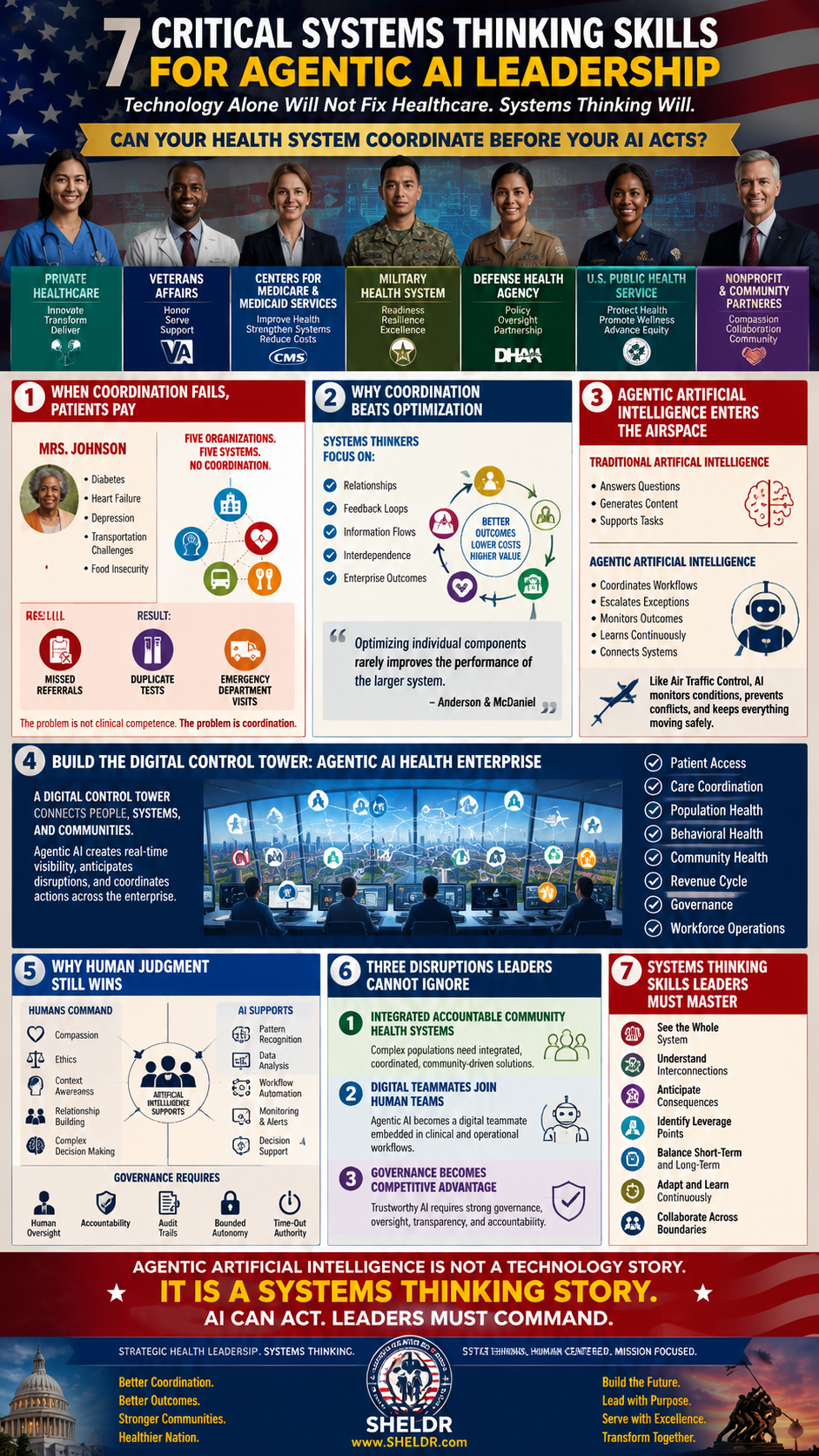
Can your health system coordinate before your AI acts?
Executive Summary
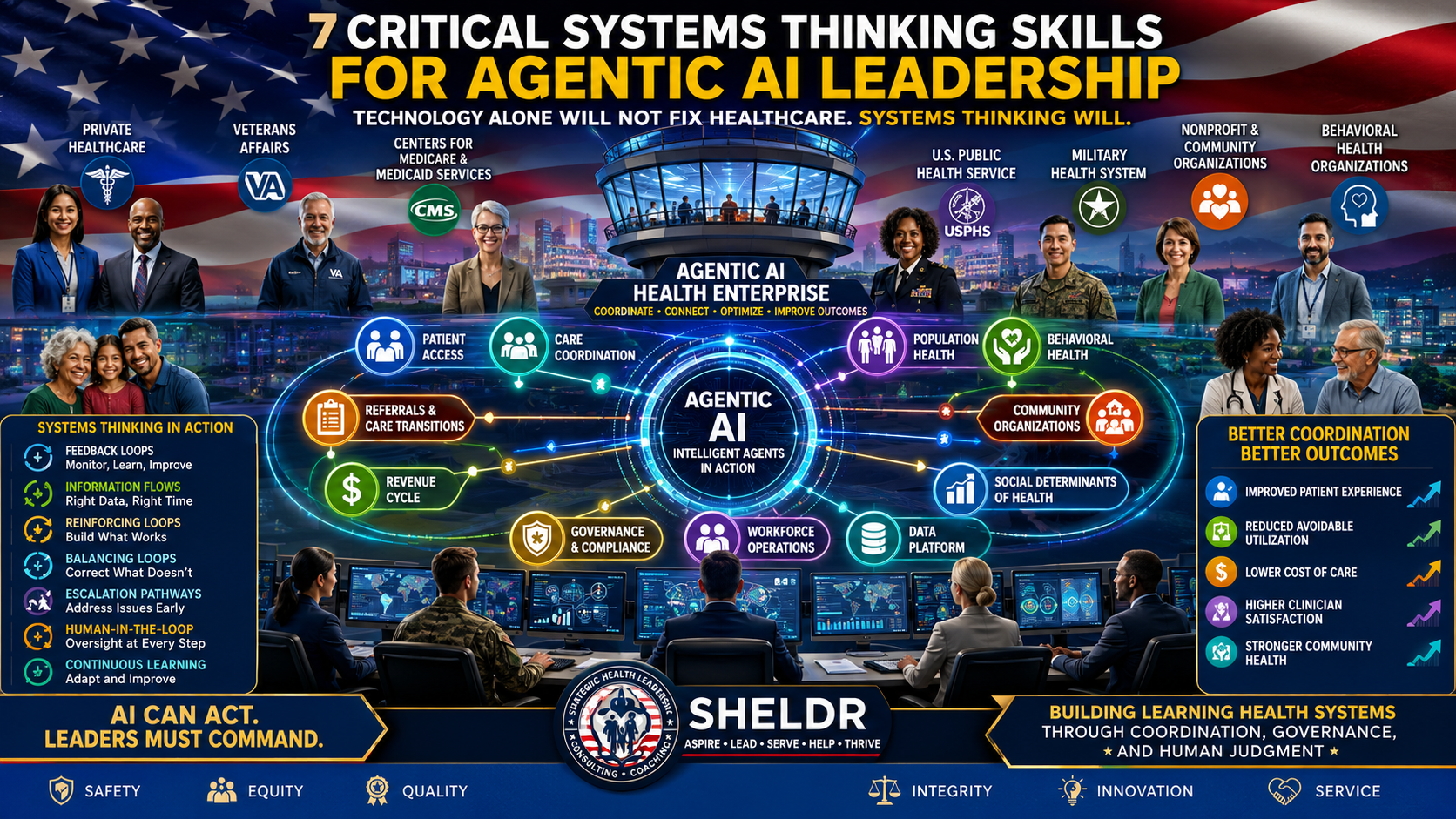
Health and Human Services (HHS) leaders face a paradox. Data volumes continue to rise while coordination failures persist. Agentic Artificial Intelligence (AI) offers a new operating model, yet technology alone will not solve healthcare’s most persistent challenges. Systems thinking provides the leadership discipline required to transform intelligent agents into enterprise assets. Organizations that combine systems thinking, governance, workflow redesign, and human judgment will create safer, more effective, and more resilient Agentic AI Health Enterprises.
When Coordination Fails, Patients Pay
Mrs. Johnson is 68 years old. She has diabetes, congestive heart failure, depression, transportation barriers, and food insecurity. Five organizations participate in her care. Her primary care clinic, cardiologist, behavioral health provider, transportation vendor, and food assistance organization each maintain separate systems. None communicates effectively.
Mrs. Johnson does everything right. She attends appointments, takes medications, and follows instructions. Yet she still lands in the emergency department.
The problem is not clinical competence. The problem is coordination. Her primary care physician cannot see behavioral health notes. Transportation services miss appointments. Community organizations operate independently.
Referral systems fail quietly.
Most health leaders recognize these failures. Few recognize that Agentic AI may finally provide the coordination infrastructure needed to address them. According to Bain & Company, agentic systems plan, act, adapt, and coordinate workflows beyond traditional prompt-response models.
Yet, the real challenge is not technology. The real challenge is systems thinking.
Why Coordination Beats Optimization
Most healthcare leaders manage parts of systems. Systems thinkers manage relationships among parts. According to Johnson, Anderson, and Rossow, systems thinking helps leaders understand how interactions among components produce system-wide outcomes.
Systems thinking examines feedback loops, delays, incentives, information flows, and interdependencies. These interactions determine outcomes. Health systems are complex adaptive systems in which patients, providers, payers, regulators, public health agencies, and community organizations continuously influence one another.
As stated in the Harvard Business Review Agentic Enterprise report, organizations realize value by redesigning workflows rather than merely deploying technology. Agentic AI succeeds when intelligent agents improve relationships among people, processes, information, and governance structures.
According to federal data, 71% of US hospitals reported using predictive Artificial Intelligence in 2024. The finding suggests that the challenge facing health leaders is shifting from technology adoption to enterprise coordination, governance, and operational integration. Simultaneously, interoperability challenges continue to impede information exchange across care settings. To paraphrase Anderson and McDaniel, optimizing individual components rarely improves the performance of the larger system.
Mrs. Johnson’s journey illustrates the problem. Each organization possesses useful information. No organization possesses the complete picture. Most healthcare organizations optimize departments. Patients experience systems. The table below highlights how systems thinkers and traditional managers approach healthcare challenges differently.
Table 1. Department Thinking Versus Systems Thinking
| Leadership Question | Department View | Systems View | Mrs. Johnson Example |
| Missed Appointment | Scheduling problem | Transportation, communication, referral, and social support issue s | The transportation barrier caused a no-show |
| Readmission | Hospital problem | Community-wide coordination issue | Medication confusion after discharge |
| Food Insecurity | Social service problem | Population health issue | Missed nutrition support referral |
| Referral Delay | Administrative issue | Information flow breakdown | The specialist never received a referral |
| Provider Burnout | Workforce issue | System design issue | Duplicate documentation burden |
Source: Adapted from systems thinking and Agentic Enterprise concepts.
Systems thinking shifts leadership attention from individual components to enterprise relationships. Health outcomes emerge from interactions among organizations, people, workflows, technology, and governance structures. Agentic AI becomes most valuable when leaders understand these relationships.
Agentic AI becomes meaningful when integrated into operational workflows.
Agentic AI Enters the Airspace
Traditional AI tools answer questions. Agentic AI participates in work.
Agentic systems perceive conditions, reason through options, execute approved actions, monitor outcomes, and escalate exceptions. Bain & Company describes agentic systems as goal-directed technologies that can coordinate workflows across multiple systems and data sources.
The distinction matters. A chatbot may summarize a referral. An agentic system can track referral completion, identify delays, contact stakeholders, and escalate concerns.
Agentic AI functions much like an air traffic control system. Pilots still fly aircraft. Controllers monitor conditions, identify conflicts, coordinate movement, and maintain situational awareness. Healthcare leaders should view agentic systems similarly.
Mrs. Johnson’s transportation challenge illustrates the difference. A traditional system records a missed appointment. An agentic system identifies transportation failure, alerts care managers, coordinates alternate transportation, and documents resolution.
Before reviewing enterprise applications, leaders should understand how agentic systems differ from earlier technologies.
Table 2. Traditional AI Versus Agentic AI
| Capability | Traditional AI | Agentic AI |
| Function | Generate content | Execute workflows |
| Memory | Limited | Persistent |
| Coordination | Single task | Multi-step processes |
| Escalation | User initiated | Automated |
| Learning | Static outputs | Adaptive workflows |
| Healthcare Example | Draft note | Close referral loop |
Source: Adapted from Bain, Deloitte, Salesforce, and HBR publications.
Agentic AI moves beyond content generation. Intelligent agents participate directly in healthcare workflows. The greatest value comes from workflow orchestration, information coordination, and escalation management rather than automation alone. Enterprise transformation occurs when agents connect fragmented subsystems.
Building the Digital Control Tower
The Agentic AI Health Enterprise integrates intelligent agents into clinical, operational, informational, governance, and community subsystems. This model resembles an air traffic control tower overseeing thousands of simultaneous flights. Information moves continuously. Risks become visible. Delays trigger intervention. Human leaders retain authority.
Salesforce reports that healthcare-focused agentic systems can coordinate patient engagement and operational workflows across multiple care settings. Deloitte notes that operating-model redesign and governance modernization determine whether agentic initiatives scale safely.
Mrs. Johnson’s care journey crosses multiple organizational boundaries. The Agentic AI Health Enterprise coordinates those boundaries through intelligent information flows.
The following table illustrates major enterprise subsystems and agentic capabilities.
Table 3. Agentic AI Health Enterprise Capability Map
| Enterprise Function | Current State | Agentic Capability | Example | Expected Outcome |
| Patient Access | Long wait times | Automated scheduling orchestration | Open appointments are identified automatically | Faster access |
| Care Coordination | Fragmented communication | Multi-party workflow management | Referral completion is monitored continuously | Better continuity |
| Population Health | Retrospective reporting | Predictive surveillance | Diabetes deterioration detected early | Earlier intervention |
| Revenue Cycle | Denial management | Prevention-oriented monitoring | Missing documentation was identified before submission | Fewer denials |
| Behavioral Health | Limited integration | Cross-domain coordination | Depression follow-up triggered automatically | Better engagement |
| Community Health | Disconnected services | Community resource orchestration | Food assistance referral is tracked automatically | Improved outcomes |
Recent federal reports estimate that administrative activities consume nearly one-quarter of healthcare expenditures. According to Sahni and Carrus, administrative waste remains a major contributor to excess healthcare spending in the United States. Simultaneously, workforce shortages continue to affect clinical operations across HHS sectors.
Agentic systems help coordinate work across these domains.
The Agentic AI Health Enterprise creates an integrated ecosystem that improves coordination across clinical, operational, governance, workforce, and community functions. Success depends on enterprise integration rather than isolated technology deployments.
Strong governance determines whether intelligent agents create value safely.
Why Human Judgment Still Wins
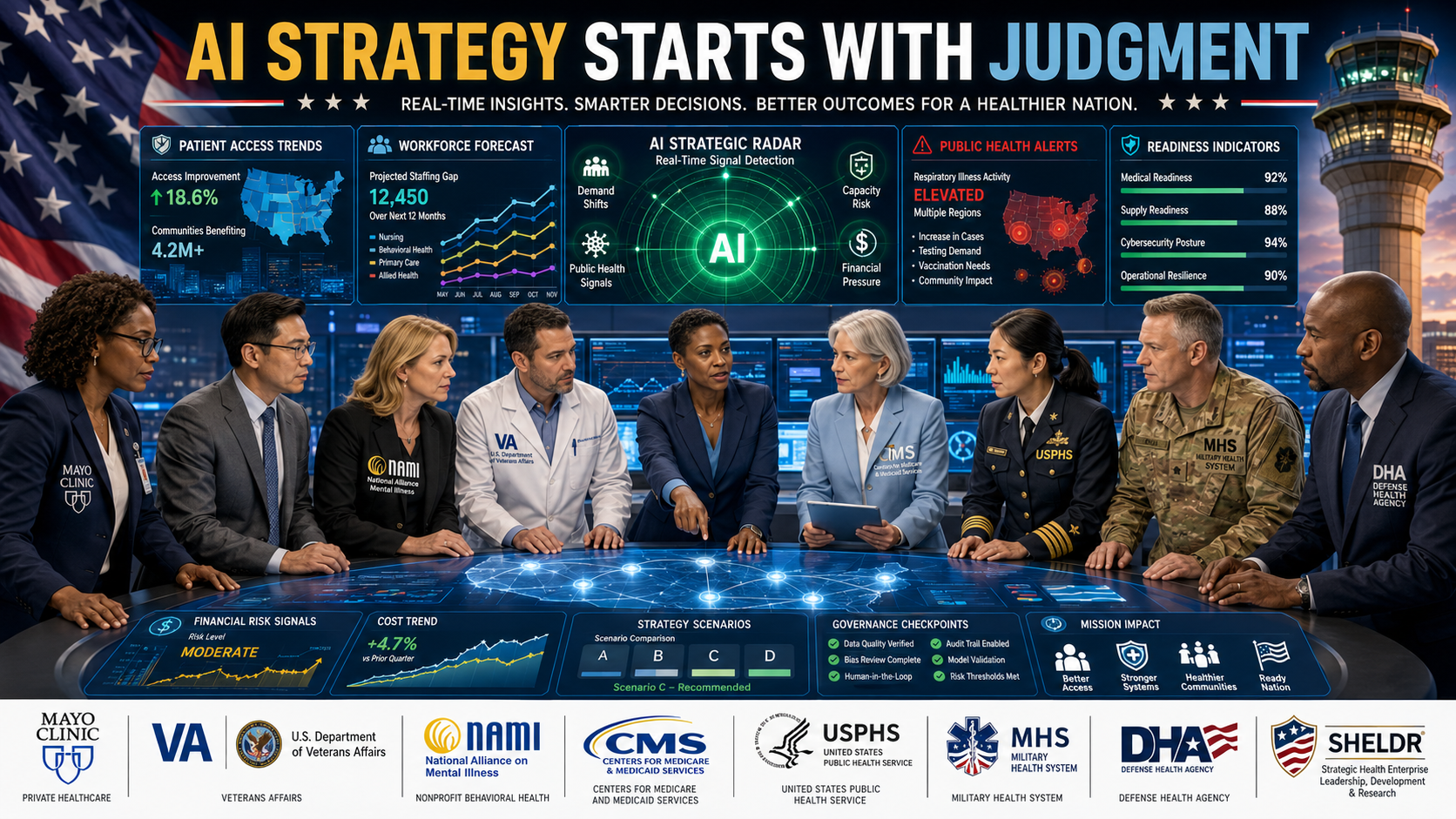
Many AI discussions focus on capability. Health leaders should focus on accountability.
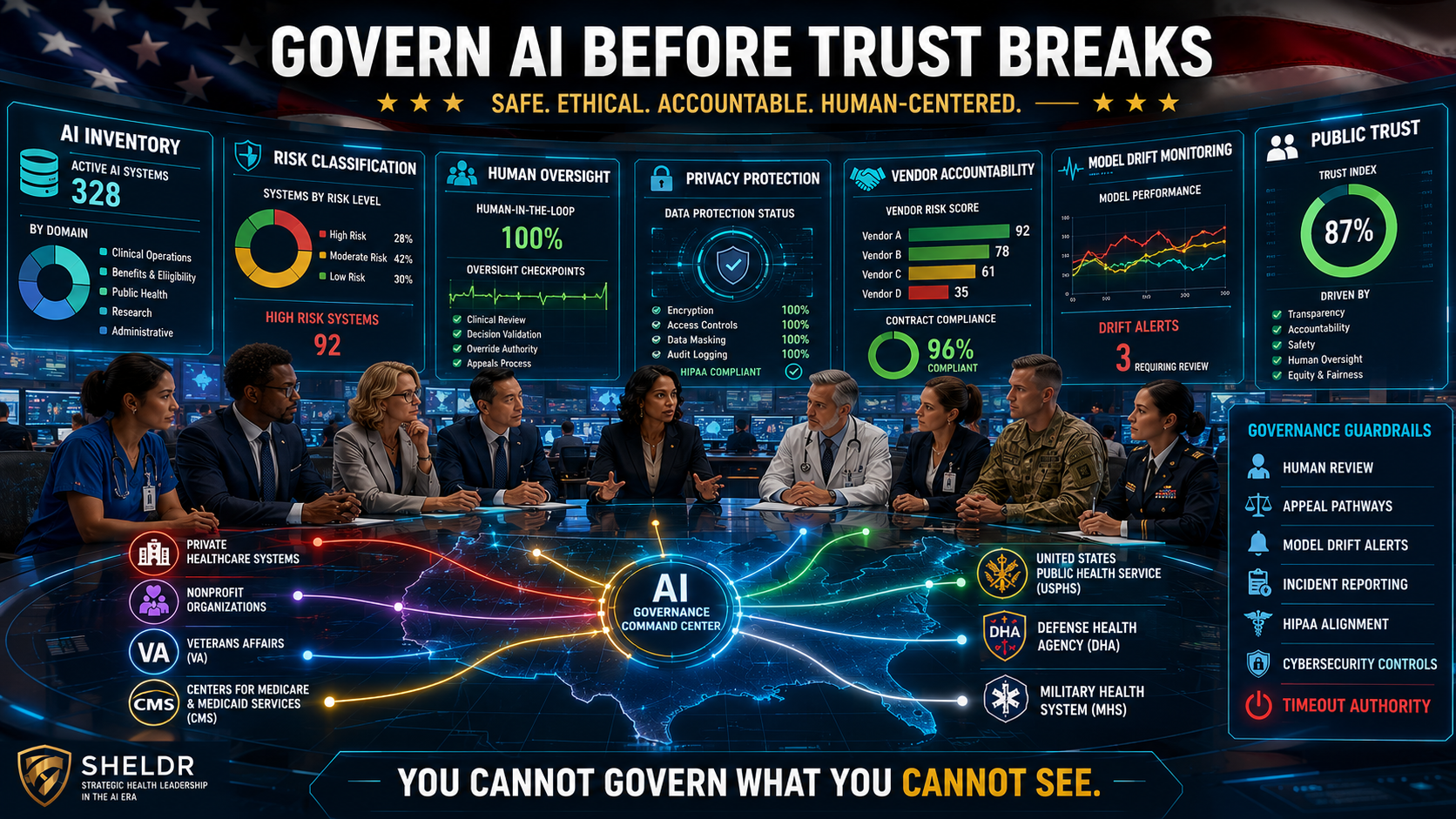
The HBR report repeatedly emphasizes bounded autonomy, human oversight, escalation pathways, audit trails, and governance controls. These principles align directly with systems thinking. Too much control creates stagnation. Too much autonomy creates instability. The Agentic AI Health Enterprise balances both forces.
HHS organizations should define what agents may read, write, initiate, escalate, and recommend. Every workflow requires a human owner. Every agent requires a supervisor. Every exception requires a documented escalation path.
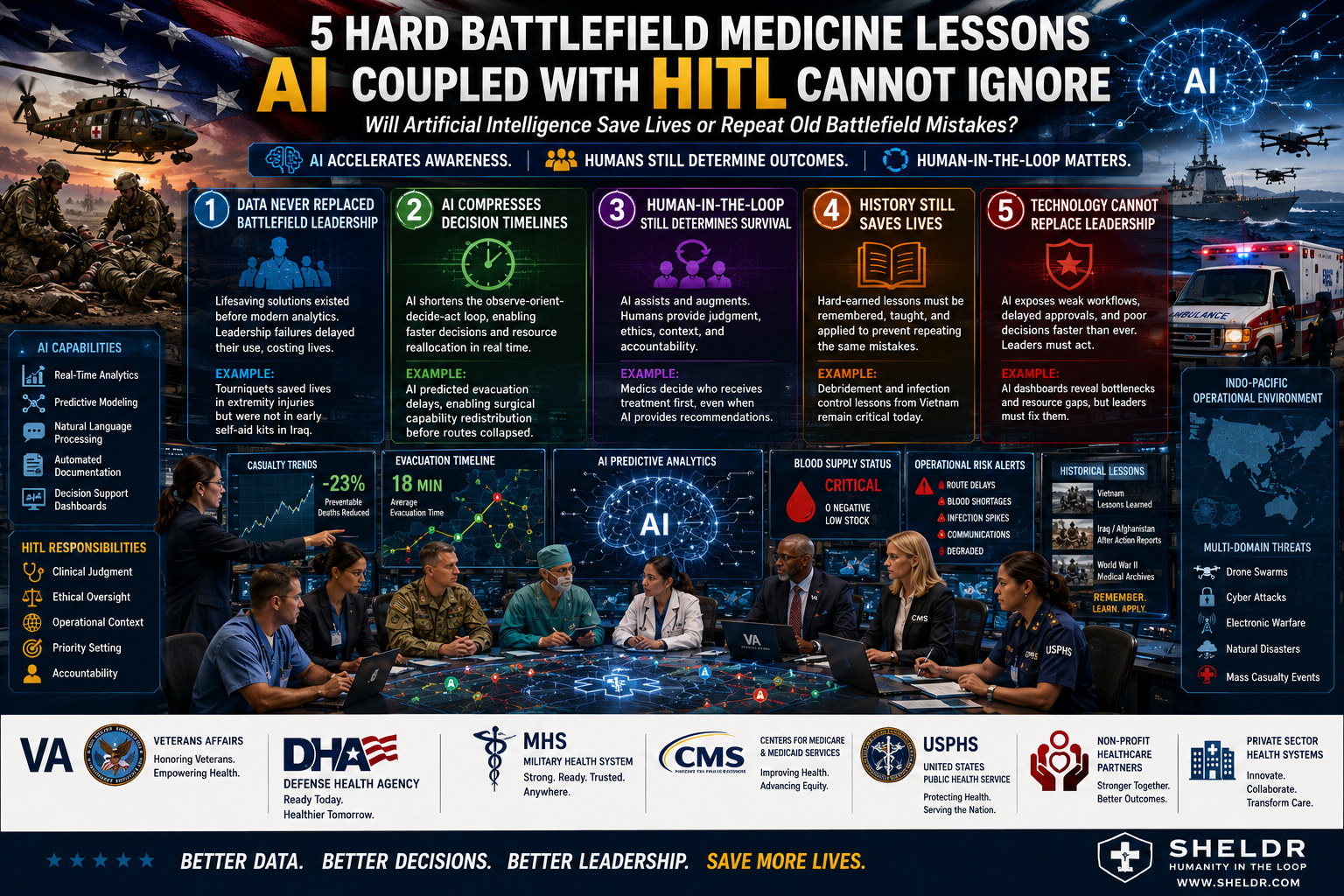
The analogy remains useful. Air traffic controllers do not fly aircraft. Pilots remain accountable. Similarly, clinicians retain authority for diagnosis, treatment, and patient relationships.
Mrs. Johnson’s medication management provides an example. An intelligent agent may identify potential interactions. The clinician decides whether to modify treatment. The following implementation roadmap summarizes recommended actions.
Table 4. Leadership Roadmap for Agentic AI Adoption
| Step | Leadership Action | Desired Outcome |
| 1 | Map workflows | Identify bottlenecks |
| 2 | Improve data quality | Trusted information |
| 3 | Define governance | Accountability |
| 4 | Establish oversight | Human control |
| 5 | Train workforce | Safe adoption |
| 6 | Measure outcomes | Continuous improvement |
| 7 | Scale successful pilots | Enterprise value |
Source: Adapted from HBR Agentic Enterprise report and healthcare governance guidance.
Governance determines whether Agentic AI creates trust or risk. Human judgment remains essential. Intelligent agents support decisions. Deloitte notes that operating-model redesign and governance modernization determine whether agentic initiatives scale safely. Leaders remain accountable for outcomes. Several emerging opportunities deserve immediate attention from health leaders.
Three Disruptions Leaders Cannot Ignore
Three developments deserve attention.
First, Agentic AI may become the operating infrastructure for Integrated Accountable Community Health Systems. Intelligent agents can coordinate healthcare, behavioral health, public health, and social service activities around patients like Mrs. Johnson.
Second, leadership roles will change. Managers will increasingly supervise digital teammates alongside human employees.
Third, governance may become a competitive advantage. Organizations capable of safely scaling intelligent agents may outperform competitors in quality, access, and efficiency.
The implication is straightforward. Healthcare organizations may soon compete less on technology acquisition and more on systems design. The winners will not necessarily deploy the most AI. The winners will design the strongest relationships among people, information, workflows, governance structures, and community partners.
The Future Belongs to Coordinators
Agentic AI is not fundamentally a technology story. Agentic AI is a systems story. Health systems rarely fail because information is unavailable. Most failures occur because information arrives late, reaches the wrong stakeholders, or fails to reach decision makers.
Systems thinking provides the blueprint. Agentic AI provides new operational capabilities.
Human leaders provide judgment, accountability, ethics, and trust. Like an air traffic control tower, the objective is not to replace pilots. The objective is to coordinate movement across a complex environment.
Health leaders should begin now. Map workflows. Identify bottlenecks. Strengthen governance. Launch low-risk pilots. Measure outcomes. Build organizational learning. AI can act. Leaders must move forward and remain in the loop!
Discussion Questions
- Which workflow bottleneck creates the greatest coordination challenge in your organization?
- What activities should never occur without human review and approval?
- How can Agentic AI accelerate Integrated Accountable Community Health Systems in your community?
References
- Johnson JK, Anderson DE, Rossow CC. Health Systems Thinking: A Primer. Jones & Bartlett Learning; 2020. https://www.amazon.com/Health-Systems-Thinking-James-Johnson/dp/1284167143
- Anderson DE, McDaniel RR Jr. Systems thinking. In: Johnson JK, Sollecito WA, eds. McLaughlin and Kaluzny’s Continuous Quality Improvement in Health Care. 5th ed. Jones & Bartlett Learning; 2020:31-48 https://samples.jblearning.com/9781284167078/9781284193558_CH02_031_048_Secured.pdf
- Holmgren AJ, Adler-Milstein J. Use of generative artificial intelligence integrated into electronic health records among US hospitals. JAMA Netw Open. 2025;8(8):e2552725. doi:10.1001/jamanetworkopen. 2025.52725. https://jamanetwork.com/journals/jamanetworkopen/fullarticle/2842683
- Sahni NR, Carrus B. The Role of Administrative Waste in Excess US Health Spending. Health Affairs. Published October 9, 2023. Accessed June 3, 2026. https://www.healthaffairs.org/content/briefs/role-administrative-waste-excess-us-health-spending
- Chang W, Everson J, Adler-Milstein J. Hospital Trends in the Use, Evaluation, and Governance of Predictive Artificial Intelligence, 2023-2024. Assistant Secretary for Technology Policy/Office of the National Coordinator for Health Information Technology, US Department of Health and Human Services; 2025. Report PDF
- Harvard Business Review Analytic Services. The Agentic Enterprise: Elevating Workforce Productivity Through Human-AI Collaboration. Harvard Business Review Analytic Services; 2025. https://hbr.org/resources/pdfs/comm/hyland/theagenticenterprise.pdf
- Bain & Company. What Is Agentic AI and How Does It Work in Enterprises? Published 2025. https://www.bain.com/insights/what-is-agentic-ai-and-how-does-it-work-in-enterprises/
- Salesforce. Healthcare Agentic AI: What It Is and Why It Matters. Published 2025. https://www.salesforce.com/healthcare/artificial-intelligence/healthcare-agentic-ai/
- Deloitte. Agentic AI in Health Care: Why Operating Model Change Matters. Published 2025. https://www.deloitte.com/us/en/insights/industry/health-care/agentic-ai-health-care-operating-model-change.html
- Coalition for Health AI. Blueprint for Trustworthy AI Implementation Guidance and Assurance for Healthcare. Published 2023. https://www.coalitionforhealthai.org
#AgenticAI #SystemsThinking #StrategicHealthLeadership