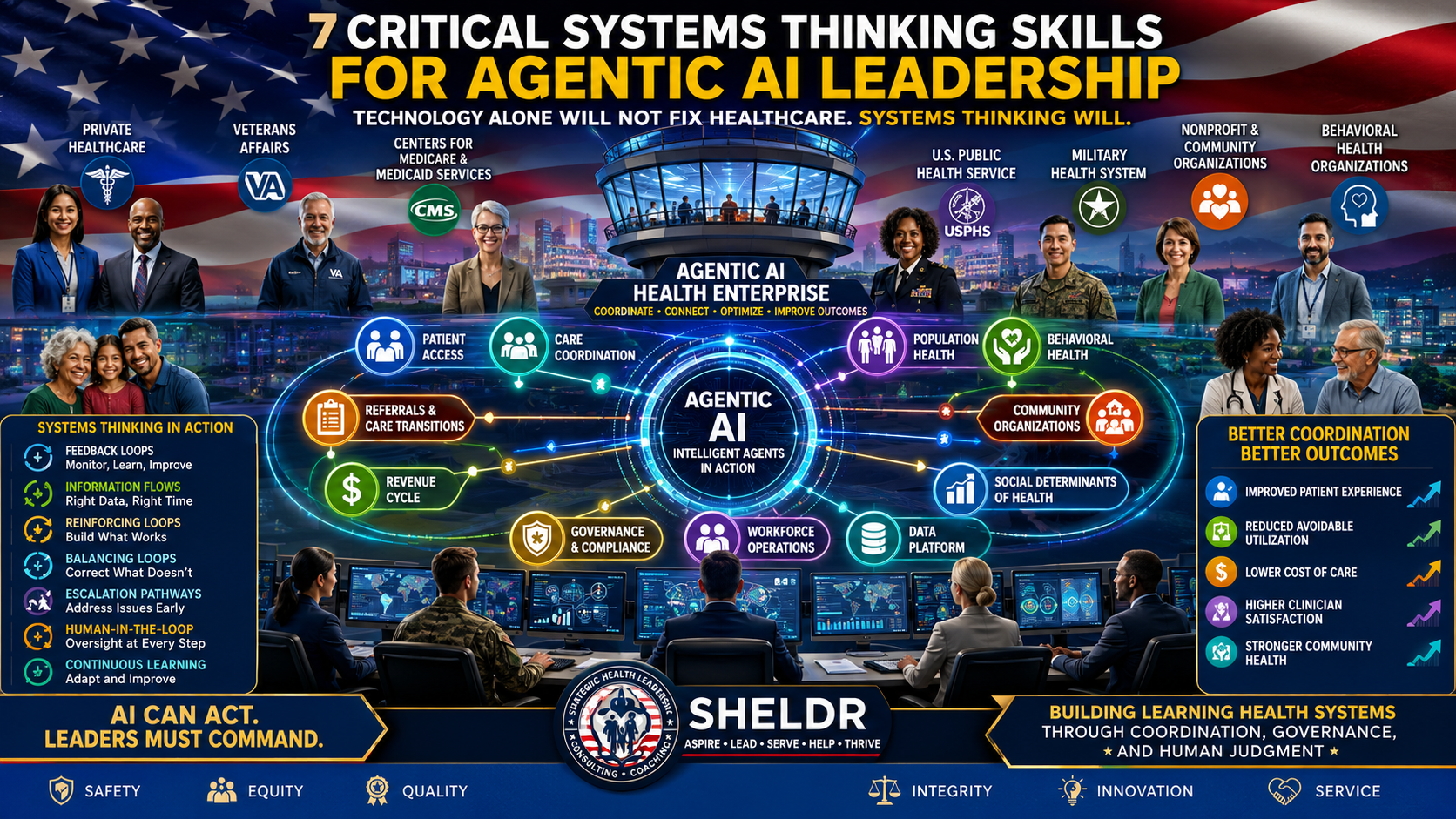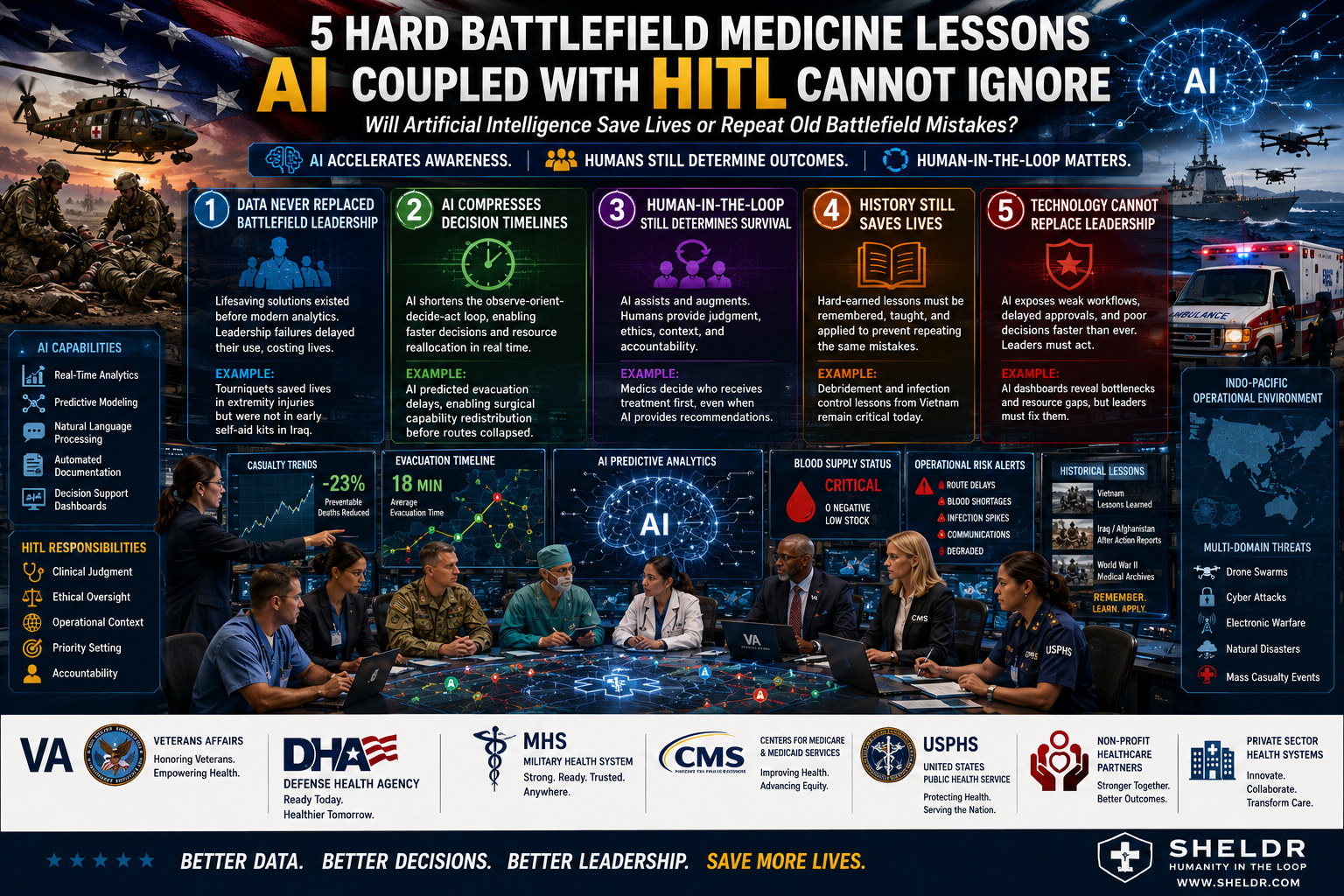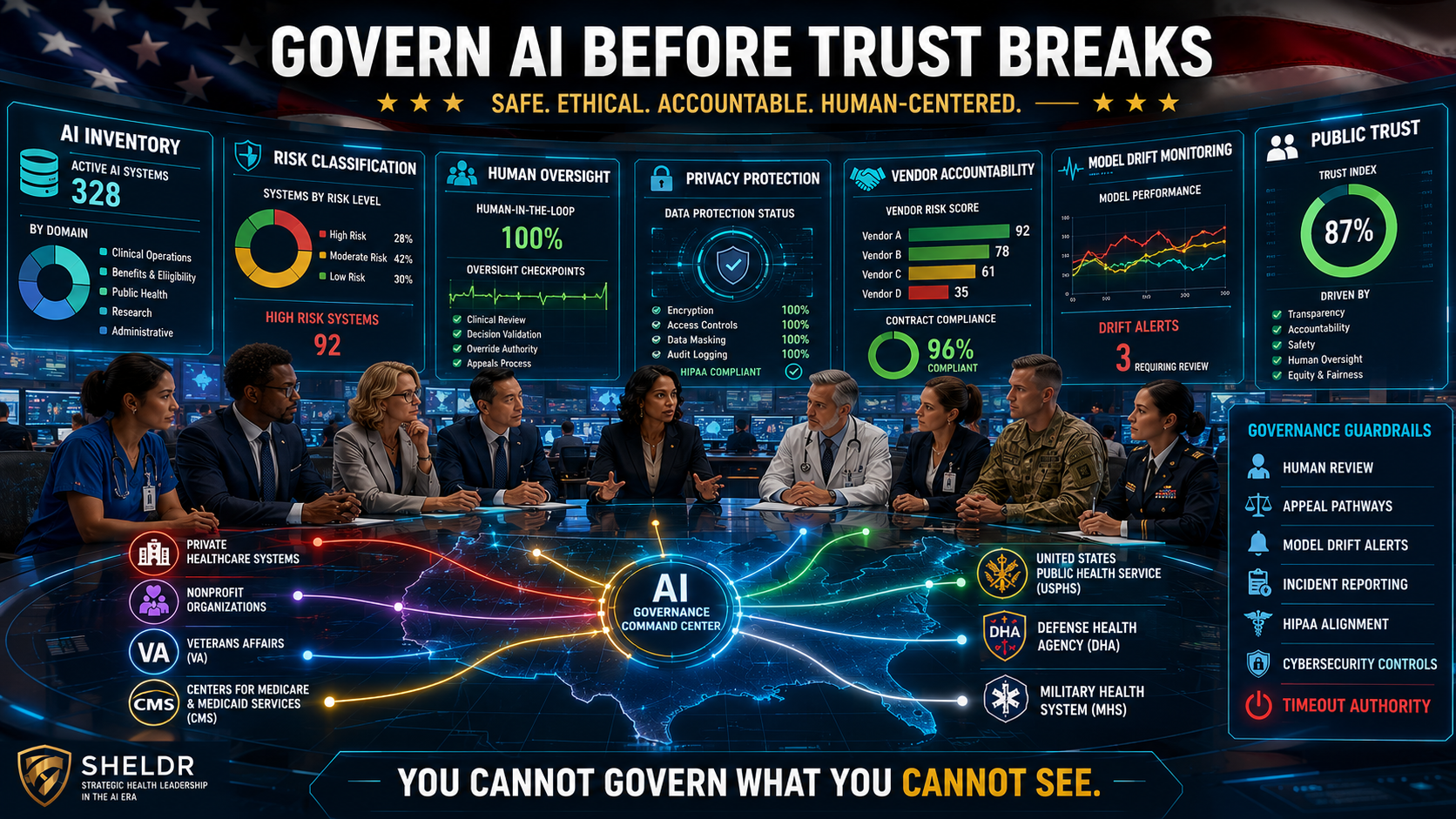
Will your AI deployment command center protect the mission or create chaos?
Executive Summary: Artificial intelligence is rapidly reshaping health and human services through administrative automation, prior authorization reform, consumer engagement, and workforce support. Yet adoption remains uneven. One-quarter of Americans already use AI for health guidance, while only 23.2% of clinicians report organizational deployment. HHS leaders must lead like disciplined commanders. Build governance first, deploy strategically, train relentlessly, and scale only after measurable success.
AI Deployment is essential for enhancing efficiency in health and human services.
AI Deployment must include measurable goals and outcomes to track progress.
Introduction to Powerful AI Deployment Strategies
Understanding AI Deployment is critical for leaders in HHS.
The importance of AI Deployment cannot be overstated, especially in administrative tasks.
Leaders must prioritize AI Deployment to ensure effective governance.
Without AI Deployment, organizations risk falling behind in innovation.
Strategically implementing AI Deployment can lead to better patient outcomes.
AI Deployment requires careful planning and execution.
AI Deployment is key to addressing operational pain points.
AI in HHS resembles the arrival of precision logistics in wartime. Properly deployed, it multiplies force. Poorly governed, it creates collateral damage. Leaders now face a strategic choice between disciplined implementation and operational drift.
Mapping operational pain to AI Deployment will yield better results.
AI Deployment must be approached with a structured governance model.
Effective AI Deployment requires training and oversight.
Healthcare AI is advancing fast, but adoption remains uneven, and trust remains fragile. Consumer demand is accelerating, yet frontline clinical integration shows a widening operational gap. Only 41% of nurses report frequent AI use compared with 57% of physicians, signaling uneven workforce penetration. At the same time, ambient documentation has become healthcare’s leading deployment zone, with 100% of surveyed health systems reporting adoption, proving that administrative efficiency, not autonomous care, remains AI’s primary beachhead.
The success of AI Deployment hinges on comprehensive training programs.
AI Deployment in healthcare requires effective communication and readiness.
That momentum masks deeper command failures. HHS has established an enterprise AI Strategy, yet many organizations still deploy tools without disciplined oversight, creating governance blind spots and “shadow AI” risks. Public skepticism compounds the threat. According to a Quinnipiac Poll, 76% of Americans rarely trust AI, while support for healthcare AI dropped from 52% to 42% in just two years.
Implementing AI Deployment thoughtfully can prevent operational drift.
Continuous assessment of AI Deployment strategies is crucial for success.
The message for HHS leaders is direct: technology deployment without governance, transparency, and workforce trust risks eroding confidence and trust. It is a strategic vulnerability that leaders must actively address. Moving forward, leaders must close adoption gaps, govern aggressively, and build trust before scaling.
Strategy I. Recon the Battlefield: Know Where Friction Lives
No military commander attacks unthinkingly. Operational reconnaissance always comes first.
Current HHS friction points include documentation burden, delays in prior authorization, scheduling inefficiencies, billing disputes, and fragmented consumer navigation. Highlighting these operational gaps helps leaders focus on critical pain points and prioritize AI solutions effectively.
| Operational Friction | Strategic AI Opportunity |
| Prior authorization delays | AI-assisted approvals and appeals |
| Documentation burden | Voice-enabled ambient documentation |
| Scheduling inefficiency | Intelligent triage and automation |
| Billing confusion | Consumer AI support |
| Workforce burnout | Administrative burden reduction |
Executives must identify where systems bleed time, trust, and margin. Map AI to operational pain, not hype. Recon without doctrine still loses wars.
Strategy II. Build Doctrine Before Deployment
Weapons without a command structure create friendly fire. AI governance is a doctrine. HHS leaders need structured oversight before scaling adoption. HHS strategy and Coalition for Health AI guidance emphasize enterprise-level governance, bias audits, privacy controls, and accountability. Here are the core governance requirements:
| Governance Function | Strategic Purpose |
| AI inventory | Full operational awareness |
| Governance council | Acquisition control |
| Bias and safety validation | Risk mitigation |
| Workforce training | Readiness |
| KPI reviews | Mission tracking |
| Incident response | TIMEOUT AUTHORITY |
Governance matters because AI adoption is accelerating, but trust still depends on safeguards, education, and human authority. Stressing this connection helps leaders understand that strong governance is essential for building confidence and ensuring responsible deployment.
Integration of AI into electronic health records, privacy protections, and rigorous workforce training remain decisive factors, ensuring AI functions as a force multiplier for efficiency, safety, and patient care.
Yet most are not prepared. No doctrine. No deployment. Governance without readiness and training stalls progress.
Strategy III. Train the Force
Prepared personnel, not software, determine mission success. Despite widespread enthusiasm for artificial intelligence, 24.7% of clinicians (and up to 68% in some studies) identify limited AI knowledge as a key barrier to adoption.
According to Stanford University, AI adoption in healthcare faces four major barriers. Clinicians cite knowledge gaps, limited training, and poor understanding of how AI generates decisions, especially the “black box” problem. Trust remains fragile due to concerns about privacy, cybersecurity, and algorithmic bias, which fuel cautious adoption. Workflow disruption is another obstacle, as many tools increase cognitive burden instead of improving efficiency. Liability and ethics also remain unresolved, with unclear regulations around accountability when AI contributes to diagnostic mistakes or patient harm.
This knowledge gap is part of a larger, complex set of hurdles that hinder the seamless integration of AI into clinical workflows.
Fear of job loss also persists. Leaders must treat AI readiness like force modernization. Training priorities include:
- AI literacy
- Privacy safeguards
- Bias recognition
- Workflow integration
- Human override authority
This training approach is not optional. It is command readiness. AI literacy is operational readiness. Ready forces still need phased engagement.
Strategy IV. Deploy Low-Risk Wins First
Successful AI adoption demands the discipline of military campaign design, not reckless technological enthusiasm. The “crawl, walk, run” model recognizes that organizations must first secure operational footholds before advancing into higher-risk clinical territory.
Leaders should begin by targeting repetitive administrative burdens where AI can produce measurable efficiency gains without jeopardizing patient safety. Early wins in documentation, scheduling, revenue cycle management, prior authorization, and consumer education create trust, demonstrate ROI, and motivate further AI adoption by showing tangible benefits.
Engaging staff in AI Deployment enhances their confidence and reduces resistance.
| Strategic Foothold | Primary Objective | Operational Benefit |
| Documentation | Automate note-taking/coding | Reduce burnout, improve accuracy |
| Scheduling | Optimize appointments/OR flow | Lower cancellations, improve throughput |
| Revenue Cycle | Predict denials, automate claims | Accelerate reimbursement |
| Prior Authorization | Match payer criteria | Reduce delays, improve approvals |
| Consumer Education | 24/7 AI guidance | Reduce call center burden |
Successful AI Deployment demands focused leadership and strategic foresight.
Once footholds are secure, discipline becomes even more critical. Healthcare leaders must resist premature deployment of autonomous diagnosis, unsupervised mental health counseling, or black-box clinical recommendations, where failure can cause catastrophic patient harm, liability exposure, and ethical collapse. High-risk AI should never outpace governance, interpretability, or human oversight. Human-in-the-loop systems remain essential to preserving trust and accountability.
Strategic patience matters. Just as commanders avoid overextending forces before securing territory, HHS leaders must prioritize risk mitigation over speed. Avoiding premature escalation protects mission integrity while preserving organizational trust, workforce confidence, and public credibility.
AI Deployment strategies must evolve with the changing healthcare landscape.
The final determinant is execution. Pilot first. Expand the second. Administrative AI victories create organizational culture change by proving value in controlled environments. Limited “shadow mode” pilots allow leaders to validate performance, identify gaps, and refine governance before enterprise-wide scaling. Yet technology alone will not determine success. Culture outweighs strategy when trust is absent. Workforce resistance, inadequate training, and weak leadership can sabotage even the most advanced systems.
The true transformation occurs when healthcare organizations evolve from fragmented operations into disciplined, data-centric enterprises. Avoid premature deployment into autonomous diagnosis, unsupervised mental health counseling, or black-box care decisions. Low-risk wins build confidence, ROI, and culture. Pilot first. Expand the second. Even strong tactics fail without culture.
Transitioning from footholds to force multiplication requires patience, trust, and strategic leadership. In this campaign, culture is the terrain that ultimately decides victory.
Addressing concerns during AI Deployment can enhance user acceptance.
AI Deployment is a critical component of modern healthcare operations.
AI Deployment deserves focused attention from all levels of leadership.
Strategy V. Win the Culture War
Maximizing benefits from AI Deployment requires ongoing evaluation and adjustment.
AI Deployment should focus on enhancing patient and provider experiences.
Effective AI Deployment strategies can bridge gaps in healthcare delivery.
AI implementation in healthcare is not primarily a technology war. It is a culture war. Many industry reports make one point clear: resistance is driven more by fear, skepticism, and trust deficits than by software limitations or budget constraints. Staff often fear losing autonomy, job security, or professional relevance.
In military terms, this resembles a unit resisting new battlefield systems not because the equipment fails, but because the troops distrust leadership’s intent. Human resistance, not technical failure, becomes the real operational threat. Leaders who ignore emotional and cultural realities risk internal sabotage, shadow AI, or passive disengagement that can quietly destroy even well-funded implementation strategies.
Fostering a culture that embraces AI Deployment is vital for future success.
The strategic answer is reframing AI as force multiplication, not workforce replacement. AI works best when it removes administrative sandbags such as documentation, scheduling burdens, and repetitive note generation, freeing clinicians to focus where judgment, empathy, and expertise matter most. This distinction is critical. AI should never automate broken systems or mask poor operational design. It must strengthen valuable human work, not dilute it. The message to staff must be direct: AI is a teammate, not a boss. Like logistics support in combat, its role is to reduce friction and expand mission effectiveness rather than replace frontline decision-makers. Winning the culture war requires disciplined leadership action.
| Element | Strategic Imperative |
| Culture Goal | Transform resistance into engaged adoption |
| Messaging | AI helps staff work smarter, not serve the machine |
| Success Metric | Active workforce adoption and measurable burden reduction |
| Key Risk | Ignoring fear, trust, and emotional resistance |
To move from resistance to readiness, leaders must communicate transparently, launch visible pilot programs, include staff in co-creation, and continuously refine implementation through feedback loops. Start small, prove value, and let trust compound. Culture determines sustainability. Suppose staff trusts the mission, AI scales. If they distrust leadership, even the best tools become casualties.
Leadership message: AI removes administrative sandbags so clinicians can fight where judgment matters. Transparent communication, pilot visibility, and staff inclusion are essential. Culture determines sustainability.
Investing in AI Deployment can lead to sustainable improvements in care delivery.
Strategy VI. Example: Prior Authorization Is the First Front Line
As of early 2026, prior authorization has become healthcare’s administrative front line, where artificial intelligence, regulatory reform, and patient access now collide. CMS is transforming prior authorization from a slow, bureaucratic chokepoint into a mandatory electronic battlefield. Beginning January 1, 2026, electronic submission, faster decisions, and public accountability are no longer optional. This shift marks a decisive operational reset for payers, providers, and health system executives.
That new battlefield now demands a disciplined strategy rather than reactive compliance.
| 2026 Prior Authorization Reality | Strategic Implication |
| Mandatory electronic prior authorization | Digital workflows become mission essential |
| 72-hour expedited turnaround | Speed becomes compliance |
| Human oversight for denials | AI cannot independently deny care |
| Public denial and turnaround metrics | Transparency becomes competitive pressure |
| Agentic AI adoption | Automation expands from intake to recommendation |
Defensive strategy now centers on governance, compliance, and trust preservation. Leaders must ensure that AI systems provide transparent rationales for denials, maintain human-in-the-loop clinical authority, and generate automated audit trails that meet HIPAA and CMS-0057-F requirements. Without these safeguards, AI-driven prior authorization risks becoming regulatory exposure, patient harm, and organizational liability rather than operational advantage.
Once defenses are secure, offensive AI becomes the strategic multiplier. Zero-touch automation can extract clinical documentation directly from electronic health records, prepopulate compliant submissions, and accelerate approvals with less workforce friction. Predictive pre-authorization can identify likely approval barriers before submission, while integrated clinical-financial AI can align documentation, coding, and reimbursement.
The executive mission is direct: reduce the 13-hour weekly physician burden, address concerns about evidence-based criteria, and protect the one in four physicians who report delayed or compromised patient care due to prior authorization.
Fix friction where pain is highest. Strategy must always serve the mission.
Build the Command Center Now
AI is already in the HHS theater. Consumer adoption is rising. Workforce interest is growing. Policy pressure is intensifying. Leaders who act now with discipline will gain operational advantage.
Your call to action: Conduct workflow reconnaissance. Build doctrine. Train your teams. Deploy low-risk systems. Validate outcomes. Expand with discipline.
Mission, margin, and morale now depend on command quality.
Learn More: AI Tools: 3 Proven Steps to Selecting The Best For Your Use- IDOTS
Discussion Questions
- Where is your organization losing the most operational ground today?
- Is your AI governance model strong enough for scale?
- Are you leading workforce confidence or fueling resistance?
References
- Coalition for Health AI. Blueprint for Trustworthy AI Implementation Guidance and Assurance for Healthcare. Published 2023. https://www.chai.org/workgroup/responsible-ai/blueprint-for-trustworthy-ai
- National Institute of Standards and Technology. Artificial Intelligence Risk Management Framework (AI RMF 1.0). Published 2023. https://www.nist.gov/itl/ai-risk-management-framework
- Agency for Healthcare Research and Quality. Artificial Intelligence and Patient Safety: Promise and Challenges. Published 2025. https://psnet.ahrq.gov/perspective/artificial-intelligence-and-patient-safety-promise-and-challenges
- Ayers JW, Poliak A, Dredze M, et al. Comparing physician and artificial intelligence chatbot responses to patient questions. JAMA Intern Med. 2023;183(6):589-596. https://jamanetwork.com/journals/jamainternalmedicine/fullarticle/2804309
- HealthIT.gov. Hospital Trends in Use, Evaluation, and Governance of Predictive AI, 2023-2024. Published 2024. https://www.healthit.gov/data/data-briefs/hospital-trends-use-evaluation-and-governance-predictive-ai-2023-2024/
- Agency for Healthcare Research and Quality. Artificial Intelligence and Patient Safety: Promise and Challenges. Published 2025. https://psnet.ahrq.gov/perspective/artificial-intelligence-and-patient-safety-promise-and-challenges
- NBC Los Angeles. More Americans Are Turning to AI for Health Advice, Raising New Questions About Accuracy and Oversight. Published 2026. https://www.nbclosangeles.com/news/national-international/ai-use-health-advice/3876251/
- Blease C, Kaptchuk TJ, Bernstein MH, Mandl KD, Halamka JD, DesRoches CM. Generative artificial intelligence in healthcare: physician perspectives on opportunities, risks, and governance. PLoS Digit Health. 2025;4(4):e000XXXX. https://pmc.ncbi.nlm.nih.gov/articles/PMC13027095/
- Physicians Practice. Medical Practice Leaders Urge Federal Guardrails for AI Adoption. Published 2026. https://www.physicianspractice.com/view/medical-practice-leaders-urge-federal-guardrails-for-ai-adoption
- HealthLeaders Media. Nurse AI Adoption Lags Behind Doctors, Survey Finds. Published 2026. https://www.healthleadersmedia.com/cno/nurse-ai-adoption-lags-behind-doctors-survey
- Shinners L, Aggar C, Grace S, Smith S. Healthcare professionals’ knowledge, attitudes, and implementation barriers regarding artificial intelligence: systematic review. J Med Internet Res. 2025;27:eXXXX. https://pmc.ncbi.nlm.nih.gov/articles/PMC12202002/
- U.S. Department of Health and Human Services. HHS Artificial Intelligence Strategy. Published 2025. https://www.hhs.gov/sites/default/files/hhs-artificial-intelligence-strategy.pdf
AI Deployment initiatives must prioritize transparency and accountability.